

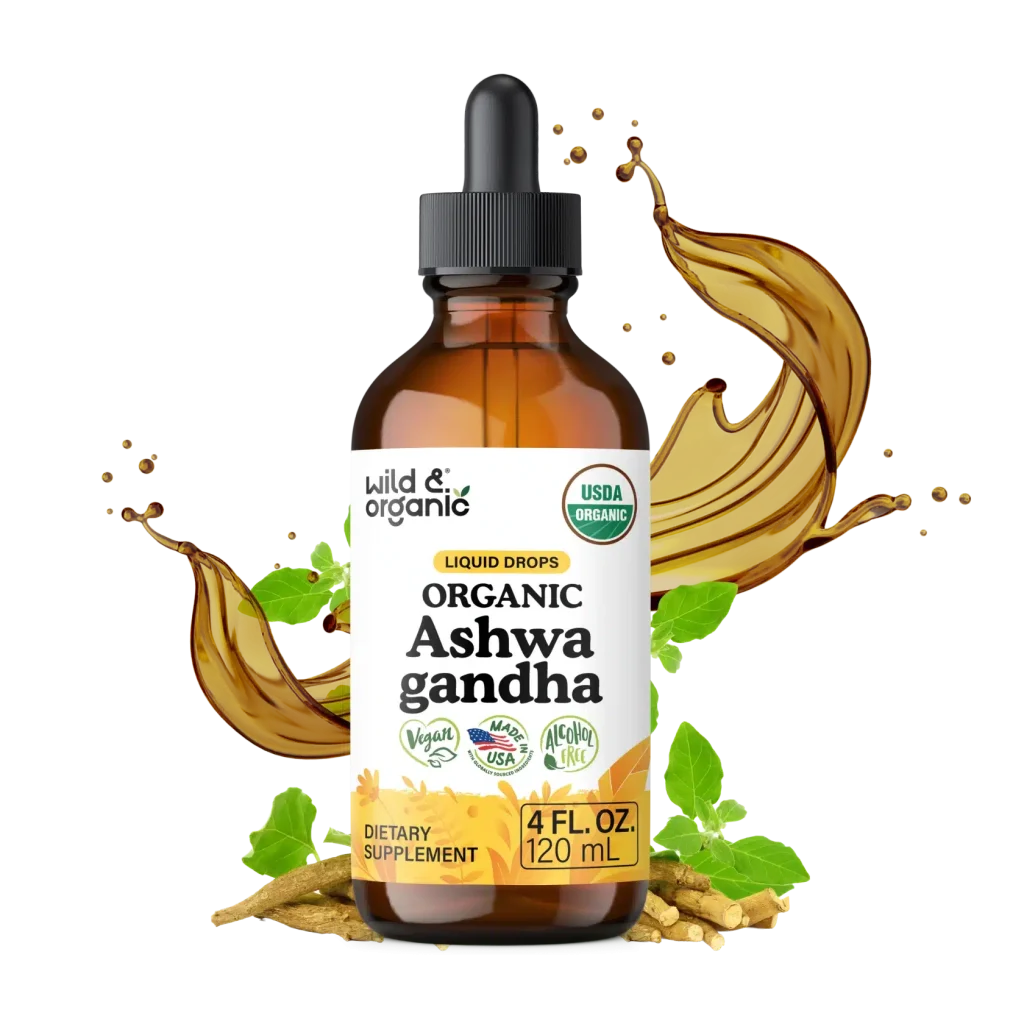
Wild & Organic’s Organic Ashwagandha Liquid Drops are a liquid supplement built around a 10:1 extract of ashwagandha root. The product page describes it as USDA Organic, alcohol-free, and vegan, with a suggested routine of three measured servings per day. Instead of swallowing a capsule, users can take the liquid directly or add it to water or juice. The brand associates the drops with daily calm and focus support, a statement about the product’s intended role rather than a guarantee of an individual result. Wildandorganic
The formula is presented in a four-fluid-ounce bottle, which the seller estimates contains about 171 servings. Each 0.7-milliliter serving provides 50 milligrams of organic ashwagandha 10:1 root extract, equivalent on the label to 500 milligrams of organic ashwagandha root. That extract-to-root equivalence, the liquid format, and the directions are the central details to understand when considering how this particular product fits into a daily routine.
What the 10:1 extract figure means
The active ingredient is listed as organic ashwagandha extract from the root of Withania somnifera. The serving contains 50 milligrams of the 10:1 extract. The product information states that this is equivalent to 500 milligrams of organic ashwagandha root. Those are two ways of describing the same serving: the amount of extract in the dropper and the quantity of root it represents according to the stated extraction ratio. They should not be read as 500 milligrams of extract in each serving.
Wild & Organic says the extract is standardized at a 10:1 ratio for consistency. The ratio gives shoppers a specific piece of formulation information, but it does not, by itself, describe every chemical component of the plant or establish how a particular person will respond. The source page does not specify a percentage of withanolides or provide a broader chemical profile, so those details cannot be inferred from the 10:1 description.
For shoppers comparing labels, the useful points to keep distinct are the serving volume, the extract amount, and the stated root equivalent. Here those figures are 0.7 milliliters, 50 milligrams of extract, and an equivalent of 500 milligrams of root. Keeping them separate makes the serving information easier to interpret and avoids treating the root-equivalent figure as the weight of the extract itself.
Liquid format and suggested routine
The directions call for shaking the bottle well before use, then taking one full squeeze of the dropper—about 0.7 milliliters—three times daily. The product page says the serving can be taken at any time of day. It may be added to two fluid ounces of water or juice, or taken straight. The page also describes the product as suitable for adding to tea, although its specific suggested-use directions name water or juice. No pills are involved, which is the defining practical difference between this liquid format and a capsule or tablet.
Because the suggested schedule is three servings per day, a person following it would use about 2.1 milliliters daily. The four-fluid-ounce bottle is listed as containing approximately 171 servings; at three servings each day, that works out to roughly 57 days of use. This is an arithmetic estimate based on the seller’s approximate serving count and stated directions, not a promise that every bottle will last for exactly that period. The page also lists a two-fluid-ounce option, but gives the approximate 171-serving count for the four-fluid-ounce bottle.
The brand notes that botanical supplements are generally best taken consistently and says many people follow a routine for at least three months. That is the seller’s guidance, not an individualized recommendation. The same product directions say not to exceed the suggested use unless a healthcare provider advises otherwise. Anyone considering a different amount or schedule should use that stated guidance as the boundary rather than assuming that a more frequent or larger serving is appropriate.
The liquid can be taken straight or diluted, so the choice is mainly about how someone prefers to take the measured serving. The listed additional ingredients include natural hickory flavor, which helps explain why the product is flavored rather than being a plain extract-and-water formula. The source does not describe the taste in detail. It does note that natural products may vary somewhat in color, smell, or taste between batches.
Ingredients and product claims
Alongside the active organic ashwagandha root extract, the other listed ingredients are certified organic vegetable glycerin, purified water, and natural hickory flavor. The product is described as alcohol-free and as containing no added sugar. It is also labeled vegan and non-GMO, with no artificial colors, flavors, or preservatives. These are the seller’s descriptions of the formula; the ingredient list is the clearest place to see the specific components named for this bottle.
“Alcohol-free” is a notable formulation detail for a liquid botanical product. In this case, the page identifies vegetable glycerin and purified water as the other principal ingredients, rather than listing alcohol as a carrier. The listing does not provide a full manufacturing formula or percentages for the inactive ingredients, so the presence of those ingredients should not be used to infer their proportions.
The listing also places the product in categories associated with sleep and relaxation, mood support, calmness support, and ashwagandha supplements. Those collection labels describe how the retailer groups the item. Separately, the product headline says it is intended for daily calm and focus support. Neither the category names nor the headline establish that the drops will produce a particular effect for each user.
Organic certification and testing information
The product page identifies the drops as USDA Organic and says the organic certification is provided by Quality Assurance International, a USDA-accredited certifier. The seller states that the herbs are grown without synthetic pesticides or GMOs and are handled according to organic standards from the farm through bottling. These details describe the certification and handling claims supplied on the product page; they are not a substitute for checking the product’s own packaging or certification information if a shopper needs to verify a particular detail.
Wild & Organic also says each new batch is tested before shipment by independent laboratories accredited to ISO/IEC 17025. According to the listing, incoming raw herbs are checked for identity, pesticides, heavy metals, and microbes, including yeast and mold. Vegetable glycerin is tested as a raw material, while finished batches are tested for heavy metals and microbes. The seller says certificates of analysis are available on request.
This description outlines what the brand says is tested at different points in production. It does not publish individual batch results in the supplied product information, and it does not name the laboratories. Customers seeking the certificate for a particular batch can ask the seller for the stated documentation rather than assuming that a general testing description includes a report for the bottle in hand.
The product is described as being made by Purus Manufacturing in Northridge, California, in a GMP-certified facility for dietary supplements. The seller also says it is made in the USA with domestic and globally sourced ingredients. That wording distinguishes where the product is made from where all of its ingredients originate: the page does not claim that every ingredient is domestic.
Storage and practical details
The storage instructions are straightforward: keep the bottle in a cool, dry place away from heat and direct sunlight, and close the cap tightly. The stated shelf life is 24 months after opening, but the printed expiration date takes precedence if it comes sooner. These details matter for a liquid product that is opened and used repeatedly, particularly for anyone planning to keep a bottle as part of a longer routine.
The listed price for the four-fluid-ounce bottle is $30.99 on the supplied page, which also shows a two-fluid-ounce selection. Prices and options can change, so the product listing is the appropriate place to check current information. The page states that standard shipping is free on U.S. orders over $69 after discounts and before tax; below that amount, shipping is calculated at checkout. It also describes a 30-day satisfaction guarantee that provides store credit for change-of-mind requests, while noting separate refund or replacement arrangements for damaged, defective, or undelivered orders. The full terms include conditions, so buyers should consult the seller’s current policy for the details that apply to an order.
Overall, the product’s identity is specific: an alcohol-free liquid with 50 milligrams of organic 10:1 ashwagandha root extract in each 0.7-milliliter serving, plus organic glycerin, water, and natural hickory flavor. Its label supplies a three-times-daily suggested schedule, a choice of direct or diluted use, and information about certification, testing, and storage. Those particulars provide a grounded basis for understanding the bottle without assuming effects or details the product page does not establish.
Get all details about Wildandorganic
Sponsored by Gabal Global Group, with publishing tools from CheapPlugins.