

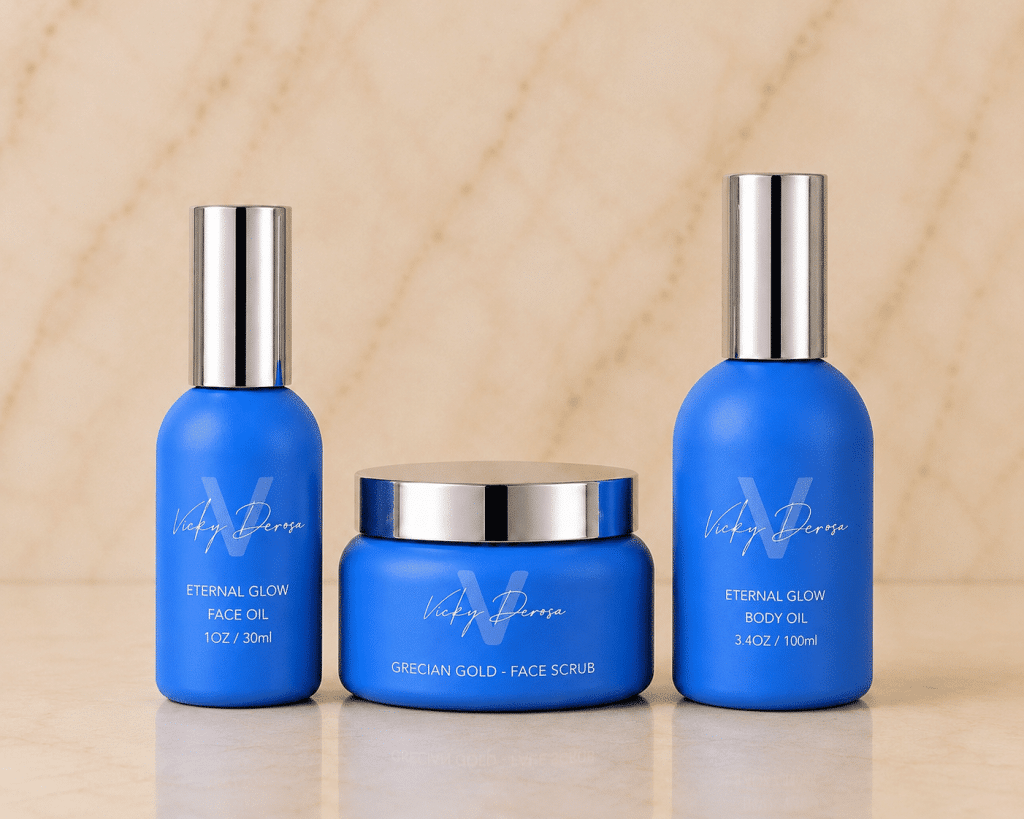
The Head-to-Toe Glow Ritual is a three-product collection from Vicky DeRosa, designed to bring a face scrub, a facial oil and a body oil into one routine. Its sequence moves from exfoliating the face to applying facial oil, then extends oil-based care to the body. The product page describes the collection as intended to exfoliate, hydrate and illuminate skin; those are the maker’s stated aims, rather than results guaranteed for every user. The set is listed under SKU VD-SET-3. Vickyderosa
The three formulas have distinct formats and directions. Grecian Gold Face Scrub is a dry powder that must be mixed with water before use. Eternal Glow Face Oil is applied in a small amount to the face and neck. Eternal Glow Body Oil is intended for broader application, with additional directions for use after bathing, in a bath or for massage. Understanding those differences helps make sense of the collection: it is not one product repeated at different scales, but a sequence of products with separate roles and instructions.
Step one: prepare and use the dry face scrub
Grecian Gold Face Scrub is the collection’s exfoliating step. The product page specifically says it is a dry powder, not a mask. To prepare it, the directions call for pouring a small amount into a cup, adding water and mixing until the powder is fully wet and forms a soft paste. Apply that paste to damp skin with gentle, circular motions, then rinse thoroughly and pat the skin dry. The page emphasizes light pressure rather than vigorous scrubbing.
The scrub’s listed ingredients are extra-fine Greek coffee, bentonite clay, Dead Sea salt, turmeric and 24K gold. The description connects the finely ground coffee with gentle polishing and says its caffeine supports circulation and vitality. Bentonite clay is described as drawing out impurities, excess oil and buildup from pores. Dead Sea salt is presented as a mineral-rich exfoliant associated with natural skin renewal. The page describes turmeric as valued for antioxidant and soothing properties and traditionally used to support an even-looking complexion. It refers to gold’s historical use for calming and illuminating properties.
These descriptions explain the maker’s rationale for combining the ingredients, but they do not replace the practical directions: wet the powder, form a paste, use light circular movements on damp skin and rinse it away. The water-activated format also means the scrub is prepared at the time of use rather than applied straight from the container as a ready-made cream. The page does not specify a frequency of use, so it would be inaccurate to prescribe a daily or weekly schedule based on this information alone.
Step two: apply the facial oil
After rinsing and patting the face dry, the product page moves to Eternal Glow Face Oil. Its suggested amount is four to six drops. Warm the oil between the hands, then gently press it into the face and neck. This makes the facial-oil step notably different from the scrub: rather than massaging an exfoliating paste and rinsing it off, the directions call for pressing a small quantity of oil onto the skin.
The listing describes the face oil as containing six essential oils and names rosehip, black seed and frankincense among them. Its ingredient information also names cold-pressed extra-virgin organic olive oil, organic rosehip oil, organic black seed oil, frankincense oil, organic castor oil and organic oregano oil. The page associates olive oil with antioxidants and fatty acids that support softness and elasticity; rosehip with vitamins A and C and smooth, radiant-looking skin; and black seed with traditional Mediterranean skin-care use. It describes frankincense as a traditional ingredient in skin and well-being rituals, castor oil as supporting absorption, and oregano oil as naturally antibacterial and rich in antioxidants.
The product description attributes further outcomes to the facial oil, including deep hydration, reduced fine lines, fading age spots, and support for collagen and firmness. Those are the seller’s claims on the page, not independently established outcomes in the supplied information. The usage instructions themselves are more specific and limited: warm four to six drops between the hands and press the oil gently into the face and neck. The page does not give a separate application amount for different skin types.
Step three: extend the routine to the body
Eternal Glow Body Oil is described as a rich but fast-absorbing formula made with 14 botanical ingredients. The product page’s main after-bath directions recommend applying it while the skin is still slightly damp. Dispense a generous amount into the palms—about the size of a quarter for each section of the body—warm it between the hands and massage it in using long, sweeping strokes. The directions suggest moving from the extremities toward the heart and giving particular attention to elbows, knees, heels and other areas that feel dry or rough. They say to allow two to three minutes for absorption before dressing.
The listed body-oil ingredients span carrier oils, vitamin E, essential oils and aromatic botanicals. They include refined olive oil, almond oil, grapeseed oil, organic rosehip oil, sesame seed oil, pomegranate seed oil, argan oil and vitamin E. The remaining named ingredients are bergamot, amyris, lavender and frankincense essential oils, plus saffron and sandalwood. The page describes olive oil as a source of squalene and polyphenols, almond oil as a lightweight source of vitamins A and E, and grapeseed oil as fast-absorbing and high in linoleic acid. Rosehip and pomegranate are associated in the listing with skin elasticity; sesame with warming and nourishing properties; argan with vitamin E; and vitamin E with helping lock in moisture.
The aromatic ingredients also give the body formula a different profile from the facial oil. The product page describes bergamot as citrusy, amyris and sandalwood as woody, lavender as floral, and frankincense as warm and grounding. It presents saffron as an ingredient associated with brightening and a more even-looking complexion. These are the maker’s descriptions of the ingredients and scent character; the page does not provide measurements or disclose the proportion of each ingredient in the formula.
Other uses and directions on the product page
Beyond after-bath application, the listing gives several ways to use the body oil. For massage, it suggests warming the bottle in a bowl of hot water, then using the oil for self-massage or partner massage. For a bath, it recommends adding one to two tablespoons to warm running water. For targeted hydration, it says to apply the oil directly to particularly dry areas, such as cracked heels, rough elbows or scaly shins, and massage it in. It also suggests an overnight application to dry areas beneath cotton socks or gloves.
The page separately describes the body oil as suitable for pregnancy and postpartum use and links that statement to rosehip, vitamin E and pomegranate seed oil. It says the product can be massaged gently onto areas including the belly, hips, thighs and breasts, and makes claims about supporting elasticity and helping prevent or fade stretch marks. These are claims from the product listing, not a medical recommendation or evidence of a guaranteed effect. The same page strongly recommends conducting a patch test before full application.
The collection is marked for all skin types in the product information. That broad label does not offer individualized guidance, and the supplied page does not explain how to adapt the routine for particular sensitivities or concerns. The patch-test recommendation is therefore a relevant instruction to note, especially because the set includes multiple botanical and aromatic ingredients. The product page also points readers toward separate information about ingredients, how to use the products, skin types and product standards, though those additional details are not included in the supplied material.
How the three products fit together
As presented, the routine is organized around a change in format and coverage: a water-mixed powder is rinsed from the face, a few drops of facial oil are pressed onto the face and neck, and body oil is applied more broadly. The scrub’s directions are the most preparation-specific, while the face oil has a concise measured application and the body oil has the widest range of suggested uses. That structure offers a clear way to distinguish the contents of the set without treating the products as interchangeable.
Vicky DeRosa says the products are handcrafted in small batches in the United States and describes the collection as made with pure ingredients, without synthetics, fillers or unnecessary additives. Those statements are the brand’s own product standards and positioning. The page does not provide further manufacturing details or define those terms, so they are best understood as the seller’s description rather than as independently verified specifications.
For someone considering the set, the useful specifics are the formulas and instructions: a five-ingredient dry face scrub mixed into a paste, a facial oil applied at four to six drops, and a body oil made with 14 named botanicals and several suggested application methods. The page supplies a detailed account of how the maker intends each product to be used, while many of its descriptions of skin benefits remain the brand’s stated claims. Keeping that distinction in view makes the ritual easier to understand as a product routine rather than a promise of particular results.
Get all details about Vickyderosa
Sponsored by Gabal Global Group, with publishing tools from CheapPlugins.