

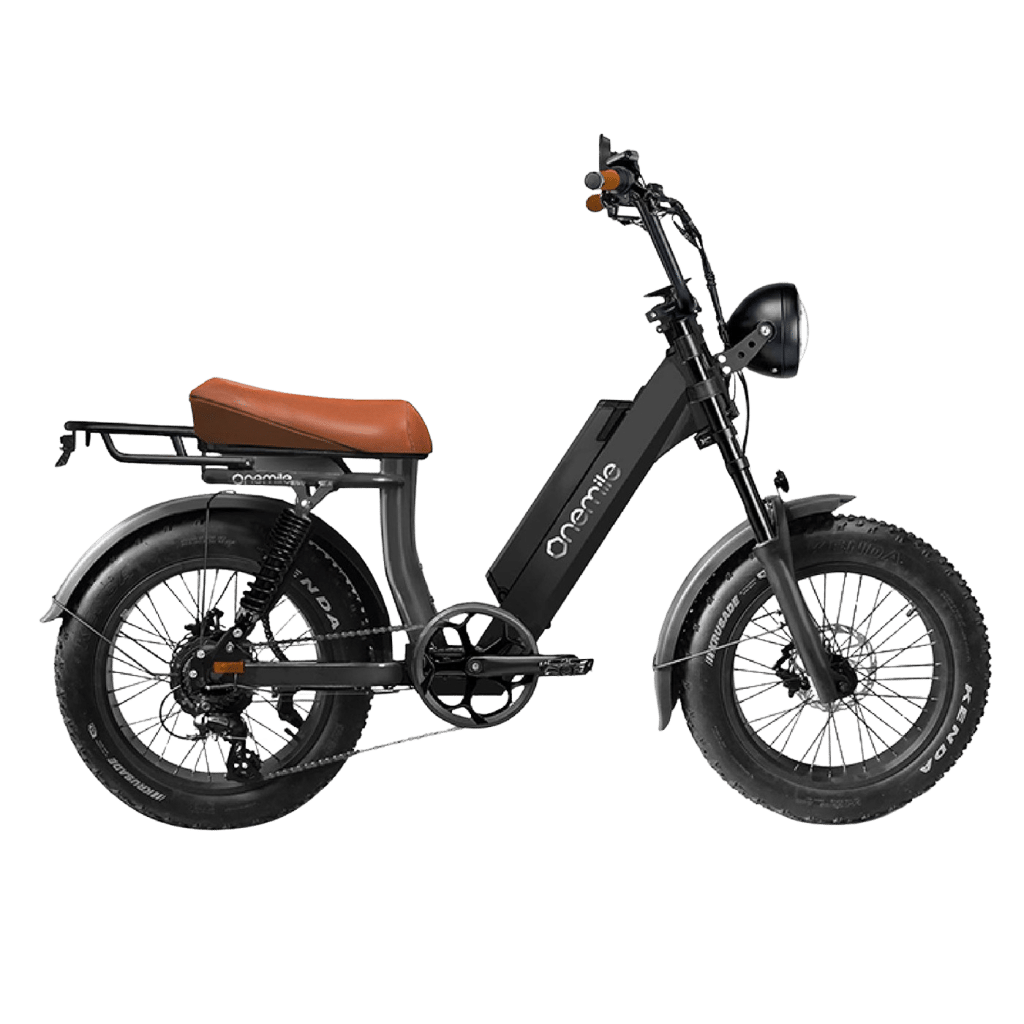
The Onemile Scrambler Fat Bikes – Moon Black / Scrambler V is presented as a speed bike for everyday journeys, with equipment aimed at combining city use and rides beyond paved streets. Its defining details include a step-through frame, a 750W peak rear hub motor, a removable 52V 14Ah battery and 20-by-4-inch tires. This guide focuses on the Moon Black Scrambler V configuration described on Onemilebike, rather than treating the wider Scrambler range as a single specification.
Onemile frames the Scrambler as a vehicle for trips such as commuting from the outskirts toward a city centre, while also listing leisure rides, camping and off-road exploration as possible settings. Those are the maker’s stated use cases, not a guarantee that every route or surface will suit every rider. The bike’s speed, range and equipment give a more concrete way to understand what this particular configuration offers.
A step-through frame with a speed-bike specification
The Scrambler V uses a step-through frame, which the product page says is intended to make mounting and dismounting easier. That design is a notable distinction from the Scrambler S, whose sports mountain frame is described as having a more robust construction and an extended seat. Those S-specific details should not be attributed to the V: the selected model here is the step-through version.
Onemile lists a top speed of 45 km/h for the Scrambler V. That figure puts speed at the centre of the product’s identity, but it should be read as a stated specification rather than a promise about what a rider will achieve. Conditions, route, rider and use of the bike can affect actual performance. The source page uses the term “speed bike” and includes a comparison table with the same 45 km/h figure for the Scrambler V/S and the more powerful Pro models.
Because the listed top speed is relatively high, prospective riders should consider the rules that apply where they plan to ride. The product page does not provide a complete explanation of local legal classifications or requirements, so the label “speed bike” alone does not establish where or how the bike may be used. Checking relevant local regulations is a practical step before choosing routes or relying on it for a particular kind of journey.
The frame specification is paired with hydraulic suspension. The product description says the V has dual front and rear hydraulic shock absorbers and presents them as a comfort feature. A comparison table describes the suspension as hydraulic damping. The source does not provide suspension travel or adjustment details, so those cannot be inferred from the general description. It does, however, make clear that suspension is part of the V’s listed setup rather than an optional accessory.
Battery capacity, range and charging
The Moon Black Scrambler V configuration is shown with a 14Ah battery. The page specifies a 52V lithium battery and gives its capacity as 728Wh; it also identifies 14 Samsung lithium-ion cells and describes a battery management system, or BMS. The maker says the BMS balances cells and includes protections relating to conditions such as overcharging, overcurrent, short circuits and wiring issues. These are descriptions of the system’s intended protections, not a substitute for following the product’s instructions for charging and use.
Onemile gives the Scrambler V/S a range of 35–60 km on a charge, while the product’s headline specification highlights a maximum of 60 km. The page associates the upper figure with pedal-assist mode and notes that range depends on riding mode. It does not offer a detailed test method or specify how factors such as route, rider weight, weather or speed affect the result. The useful takeaway is therefore the stated range band, not an expectation that every ride will reach its maximum.
The battery is removable and described as having an anti-theft lock. Onemile presents removal as a way to take the battery indoors for charging or storage, including at home or in an office. That arrangement may be relevant for someone who cannot conveniently park near a charging point, though the page does not describe the charging facilities available at any particular location. The removable design also means that owners should consult the supplied product guidance for the correct removal, locking and charging procedure.
For charging, the comparison table lists a 58.8V, 3A charger and a charging time of three to four hours for the Scrambler V/S. The product page repeats the three-to-four-hour estimate for the 14Ah version. These are the manufacturer’s listed figures, not a guarantee of an identical charging time in every circumstance. They help distinguish the standard 14Ah configuration from the Pro comparison model, which is listed with a larger 19.2Ah battery and a five-to-six-hour charging time.
Motor, gears and braking equipment
The Scrambler V is specified with a rear-wheel hub motor rated at 750W peak power and a maximum torque figure of 65Nm. Onemile says the motor is intended to provide strong acceleration and assist on climbs. Peak power and torque describe aspects of the motor’s stated output; the page does not give a separate continuous power rating or independent performance measurements. This distinction is useful when comparing specifications: the 750W figure is explicitly presented as peak power.
A Shimano ALTUS seven-speed derailleur supplies the listed gear range. The maker describes the gearing as having closely spaced steps between primary sprockets for smooth pedalling, and says the design is intended to support precise shifting. The gearing is a separate part of the riding setup from the motor: the bike has both electric assistance and a seven-speed drivetrain. The page does not specify gear ratios, so it is not possible to calculate a particular cadence or climbing speed from the available details.
Braking is handled by NUTT hydraulic disc brakes with 203mm discs, according to the comparison table. The product text also refers to a dual hydraulic braking system and presents it as equipment for responsive stopping. These are manufacturer descriptions; the source does not publish stopping-distance results. As with any bike, braking behaviour depends on conditions and maintenance, so the specification is best understood as a description of the hardware rather than an assurance of performance in every situation.
The Scrambler V also has a full-colour LCD display, described as a four-inch screen. It shows riding information and supports five pedal-assist levels, identified as modes 0–5 in the listing. The display has a startup-password feature: the page says riders can set a password that must be entered before operating the bike. That is a listed access-control feature, not a claim that the bike cannot be moved or stolen by other means.
Wide tires and intended riding contexts
The product page identifies 20-by-4-inch tires and, in its main equipment summary, names Kenda Snow tires. A separate FAQ entry refers to CST Scout tires, creating an inconsistency within the supplied page. The comparison table names Kenda Snow tires for the Scrambler V/S and CST Scout tires for the Pro model. Since the Moon Black Scrambler V is the focus here, Kenda Snow is the tire specification associated with it in the comparison table, but buyers should confirm the tire fitted to the exact unit they are considering.
The wide tire format is part of the Scrambler’s fat-bike design. Onemile lists settings including urban exploration, daily commuting, beach cruising, camping and off-road exploration. Those examples describe the variety of situations the maker has in mind; they do not establish that the bike is equally suitable for every beach, trail or road. The page supplies no terrain-specific testing details, tire-pressure guidance or restrictions, so riders should use the product documentation and consider the demands of their intended routes.
Lighting is another listed part of the specification. The comparison table says the V has a front light with daylight, low-beam and high-beam functions, plus a rear backlight and brake light. It lists turn signals for the Pro models, but not for the standard Scrambler V/S. That distinction matters when comparing configurations: the presence of turn signals should not be assumed for the Moon Black V based on the Pro version’s equipment.
What the V specification clarifies—and what it does not
Within the Scrambler family, the V is differentiated by its step-through frame, while the S is described as having a sports mountain frame and an extended seat. The comparison table groups the V and S together on several specifications, including the 750W peak rear hub motor, 52V 14Ah battery, Shimano ALTUS seven-speed gearing, 203mm hydraulic disc brakes, 45 km/h top speed and 35–60 km range. These shared figures help explain why the two models can appear similar in a specification list even though their frame designs differ.
The Pro comparison is useful mainly as a boundary around the V’s equipment. The Pro is listed with a 1000W peak silent helical gear hub motor, a 19.2Ah battery, 75Nm torque and a 45–80 km range. It is also shown with a different tire and added turn signals. Those are Pro specifications, not upgrades that should be assumed to come with the Moon Black Scrambler V. Keeping the versions separate avoids reading the strongest figures on the page as if they all describe one bike.
For someone assessing the Scrambler V, the most relevant questions are therefore practical: whether a step-through frame suits their preferred riding position, whether the listed 35–60 km range fits their expected journeys, and whether the bike’s speed classification is appropriate for the places they intend to ride. The removable battery, seven-speed gearing, hydraulic brakes, suspension, display and wide tires round out the described package, but the page does not provide every detail a buyer might want, such as full dimensions, total bike weight or a measured range protocol.
In short, the Moon Black Scrambler V is a specific combination of a step-through fat-bike frame and a speed-oriented electrical system. Its published specification centres on a 750W peak rear hub motor, 65Nm torque, a 52V 14Ah removable battery, a stated 35–60 km range and a 45 km/h top speed. The equipment list adds hydraulic suspension, NUTT hydraulic disc brakes, Shimano ALTUS seven-speed gearing, a colour LCD display and 20-by-4-inch tires. Reading those details alongside the model distinctions and the page’s limits gives a clearer picture of what Onemile lists for this configuration—without treating advertised range or intended use cases as guarantees.
Get all details about Onemilebike
Sponsored by Gabal Global Group, with publishing tools from CheapPlugins.