

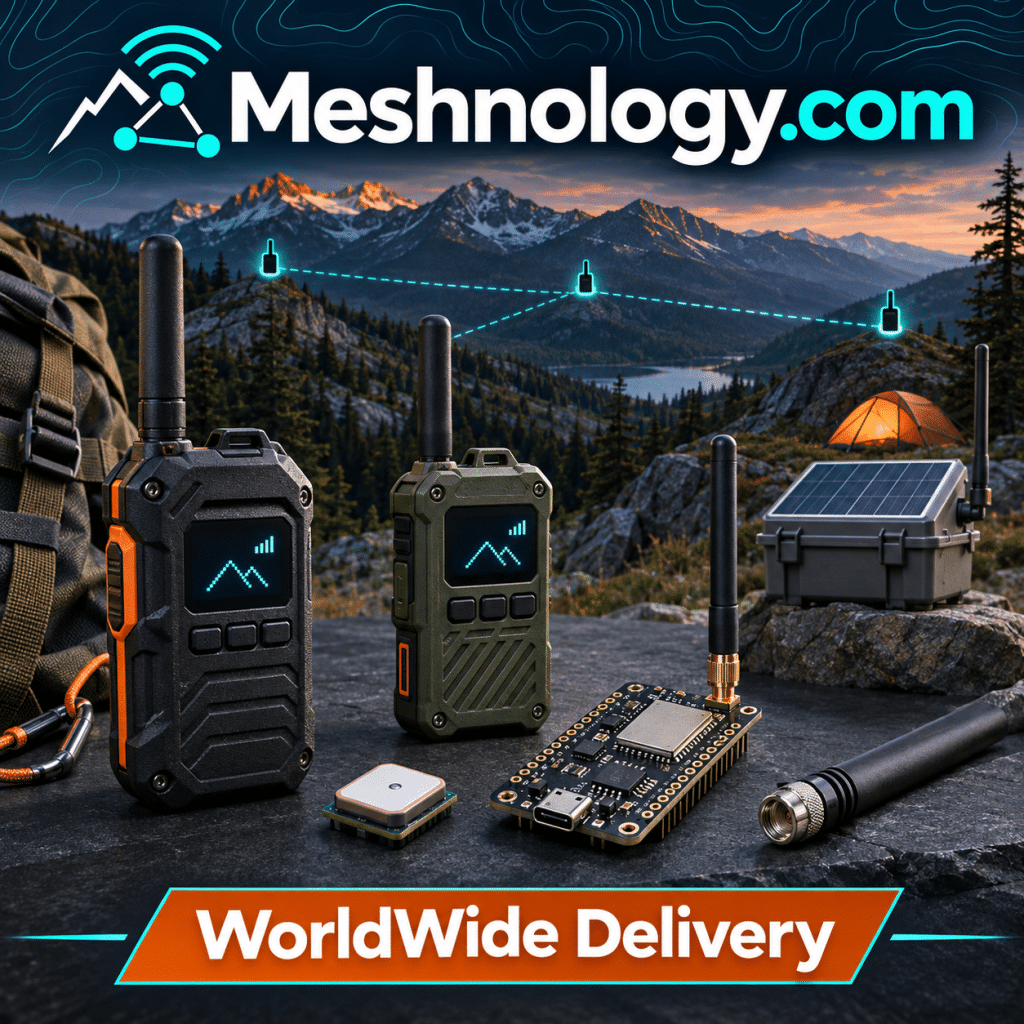
Meshnology is a store focused on LoRa communication hardware, Meshtastic devices and development boards for projects that do not depend on cellular coverage. Its catalog brings together ready-to-use radios, board-level hardware, accessories and learning resources, giving newcomers and experienced builders several ways to approach a mesh-network project. The company’s range and support materials are collected at Meshnology.
Rather than presenting one device as the answer for every use, Meshnology groups its offerings around different needs: an introductory handheld node, GPS functions, an e-ink screen, development work or a fixed outdoor installation. The site also provides setup documentation and community resources. That combination makes the company worth understanding as an equipment-and-information source for people planning a mesh communications build, not simply as a shelf of individual radios.
A catalog organized around different roles
The store describes its N Series as pre-built ESP32 LoRa Meshtastic devices, and says the complete devices include a battery, antenna and protective case. Within that family, the product descriptions distinguish models by their intended role. The N30 is presented as an easy way to get started; the N37 and N39 product listings identify GPS as a feature of the N37 line, while the site’s selection guide specifically points users who need GPS toward the N37/N39 category. The N37E is highlighted for its e-ink screen. These descriptions offer a first way to narrow a choice, although the pages do not establish that every configuration or variation has identical components.
Meshnology’s guidance also identifies a separate fixed-installation option: the Mesh Tower S1 V2, described as an outdoor, solar-powered node. That makes it a different kind of choice from a portable unit. The site’s off-grid setup illustration shows how portable nodes, a base station and a higher-point relay might be arranged together. In its camping example, the suggested purpose is keeping a small group connected around a campsite and nearby trails. These are presented as possible setups rather than guarantees about coverage in a particular location.
Elsewhere in the N Series, the N35 and N39 listings refer to Heltec WiFi LoRa 32 V3 or V4 hardware, and the N32 Plus listing identifies a Heltec ESP32 LoRa V3 basis. Meshnology also lists an N33 device kit with LoRaWAN and Arduino IDE in its product description. The series therefore sits between a finished communication device and a more configurable hardware project: the catalog includes named devices and kits, while its development-board section caters to people building or adapting their own systems.
Choosing by project, not just by model number
Meshnology’s own selection prompts are a useful starting point because they map products to practical requirements. Someone exploring Meshtastic for the first time is directed toward the N30. A GPS requirement points toward the N37/N39 area of the guide, and a preference for an e-ink display points toward the N37E. For a permanent outdoor installation, the site names the solar-powered Mesh Tower S1 V2. These categories help frame a decision around what the device is expected to do, rather than treating a longer model number as a measure of quality or suitability.
It is also important to distinguish a ready-to-use node from a development board. Meshnology’s store carries both. Its N Series page describes complete devices, while the separate development-board collection includes hardware from Meshnology, Heltec, Seeed and other vendors. That collection mentions ESP32 and ESP32-S3 boards, LoRa, Meshtastic compatibility and LoRaWAN, with possible project areas such as GPS tracking, environmental monitoring, smart agriculture and wireless sensor networks. These are examples of applications identified by the store, not a promise that any particular board is ready-made for each use.
For a buyer, the practical question is therefore how much of the project should arrive assembled and how much should remain open to development. A complete device is the more direct route when the goal is to start with a node; a board or expansion kit leaves more room for building and experimentation. Meshnology lists a Heltec WiFi LoRa 32 V4 expansion kit with optional front-panel and sensor selections, including a buzzer, a temperature-and-humidity sensor and a BME280 atmospheric-pressure sensor. The listing signals a modular approach, but builders should consult the relevant product details for what is included in a specific selection.
Accessories and the broader build
The catalog extends beyond radios and boards. Its related listings include batteries, LoRa antennas, modules and sensors, alongside power and outdoor-node categories. For someone assembling a system, this matters because a communication setup is not always a single purchase: the device, antenna, power arrangement and installation context all need to be considered together. The available source pages identify these accessory categories, but do not provide enough consistent detail to compare every specification or establish compatibility across all combinations.
That limitation is especially relevant when planning a network rather than an isolated node. Meshnology’s diagram depicts handheld nodes, a LoRa node and a relay, with a phone connected by Bluetooth and messages moving through the illustrated arrangement. The accompanying note cautions that actual routing, range and performance depend on the device, terrain, antenna and network configuration. This qualification is central to using the store’s examples responsibly: an illustrated layout can help explain a concept, but it does not predict how far a signal will travel in a specific landscape or how a group of devices will behave after deployment.
The same care applies to the store’s references to off-grid use, outdoor adventures, emergency communications and community networks. These are stated as possible applications for the products, not as assurances that a particular arrangement will provide dependable communication in every emergency or environment. Anyone planning for a safety-critical use would need to assess the devices and network in the conditions where they intend to rely on them.
Documentation and community resources
Meshnology presents its resources as part of the product ecosystem. Its site points to a wiki for setup guides, documentation and troubleshooting, as well as YouTube material described as field tests, setup guides and product demonstrations. It also lists Instagram, Facebook and Discord as places for product updates, field content and discussion about hardware and mesh setups. These channels give customers several routes to learn about the devices, though the source pages do not specify how quickly particular questions are answered or what level of support is available through each channel.
The company also highlights support for the Sioux Empire Amateur Radio Club in Sioux Falls, South Dakota. Meshnology says it supplied hardware for one of the club’s community activities and describes its interest in supporting radio clubs and hands-on work around communication, experimentation and the radio hobby. This is a specific example of community involvement on the company’s page, rather than evidence of a broader program or a claim about the results of the activity.
For people assembling a first system, the most useful sequence is to settle the intended role before comparing model names: portable messaging, GPS, a display, a fixed outdoor relay or development work. Then check the exact product configuration and its included parts, and use the documentation to understand setup requirements. Meshnology advertises technical support and ready-to-use US and EU fulfillment on its homepage, but the supplied pages do not provide further details about support procedures or fulfillment terms.
A practical way to read Meshnology’s range
Meshnology’s identity is clearest in the way it brings several layers of the LoRa and Meshtastic hobby into one catalog. Its ready-to-use N Series is aimed at people who want a complete node; its GPS and e-ink options address particular device preferences; its solar-powered outdoor node speaks to fixed installations; and its development boards and expansion kits serve builders who want to configure hardware for a wider project. Batteries, antennas and sensors sit alongside those main categories, while the wiki and community channels provide routes for further learning.
The breadth can be useful, but it also means that a short model label is not a substitute for checking a listing. The product pages cover different underlying boards, configurations and intended uses, and the store’s own network illustration warns that field performance varies. A sensible comparison starts with the job the device must perform and the configuration offered, then accounts for terrain, antenna and network design. On that basis, Meshnology is best understood as a source for both finished mesh-radio devices and the components and resources used to build a larger off-grid communications setup.
Get all details about Meshnology
Sponsored by Gabal Global Group, with publishing tools from CheapPlugins.