

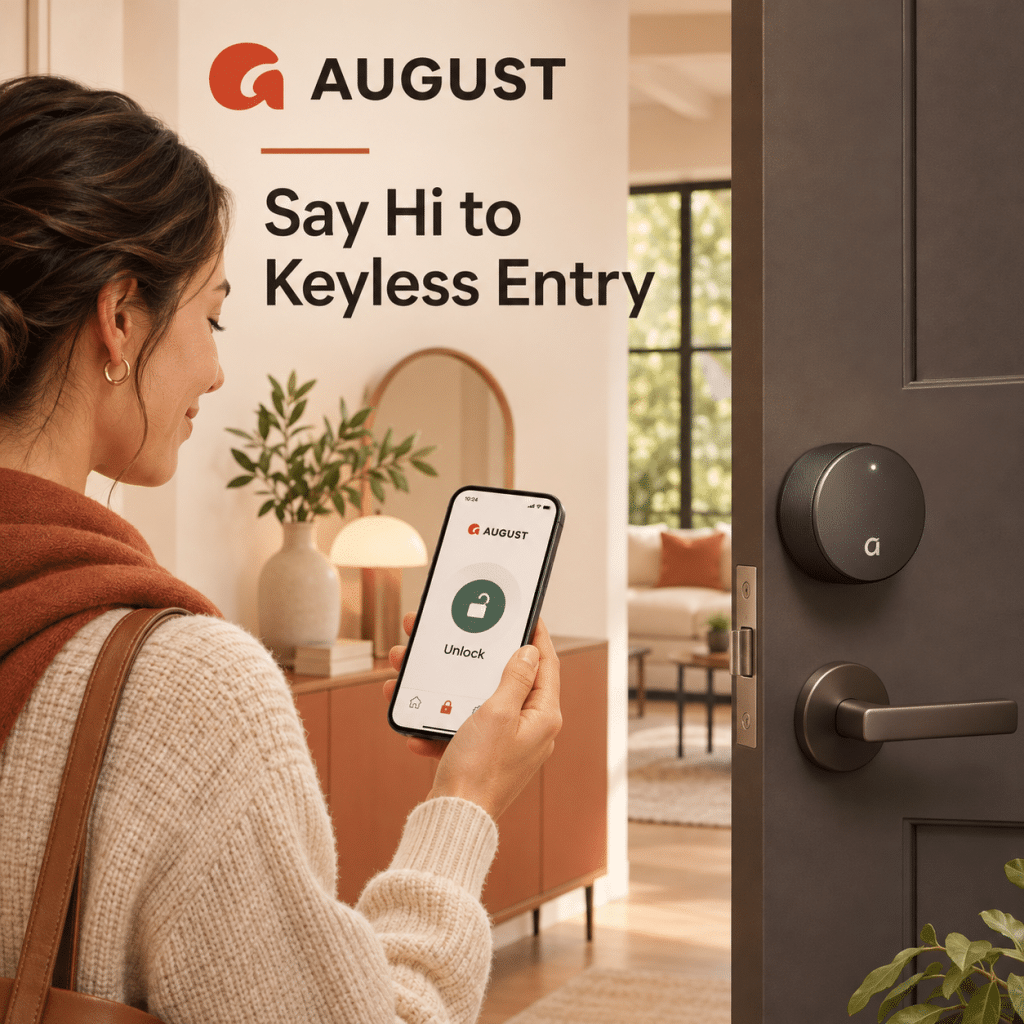
A smart lock does not have to mean replacing the visible hardware on the outside of a door. The August Wi-Fi Smart lock is designed as an interior-side upgrade: it attaches over a compatible existing deadbolt, while the outside lock and original keys remain in use. That makes the product’s central idea less about changing how a door looks and more about adding digital ways to operate and manage access. August describes the lock as an all-in-one model with Wi-Fi built in, so remote features do not require a separate bridge.
The August August Wi-Fi Smart lock combines smartphone and Apple Watch control with features for checking door status, sharing access and automating locking and unlocking. Its appeal depends in part on how a household wants to handle entry: residents can continue using existing keys, use the August app, or add a compatible keypad for code or fingerprint access. Understanding the installation approach, connectivity requirements and available access options helps clarify what this particular lock is designed to do.
A smart upgrade that stays on the inside
The product page describes the lock as fitting over an existing single-cylinder deadbolt. Rather than replacing the exterior portion of the lock, the August unit attaches on the inside of the door. In practical terms, that design preserves the original key-operated hardware, so a physical key remains one of the ways to enter. The manufacturer characterizes installation as renter-friendly and says the process takes less than 10 minutes, with minimal assembly. Those are the company’s stated installation details; whether a particular door is suitable still depends on deadbolt compatibility.
August says its smart locks work with most single-cylinder deadbolts and directs shoppers to check compatibility before buying. The product’s stated requirements include a compatible single-cylinder deadbolt, an iOS or Android smartphone and a Wi-Fi internet connection. The listed Wi-Fi specifications are 802.11 b/g/n at either 2.4 GHz or 5 GHz. The August app is available for iOS and Android, and the product page also names Apple Watch as a way to control the lock. The page lists the lock’s dimensions as 72 millimetres in diameter and 46 millimetres in depth.
The package contents listed on the product page include the August Wi-Fi Smart lock, a DoorSense sensor, two CR123 batteries, a lock adapter and mounting hardware. These details help set expectations about the basic installation kit, while the compatibility check remains important: the listing does not claim that the device fits every lock or door. August also states that its smart locks come with a one-year warranty.
Wi-Fi built into the lock
Some smart locks rely on a separate bridge to connect the lock to a home network. August presents this model differently: Wi-Fi is built into the lock, and the company says an additional bridge is not needed for remote access or voice-assistant functionality. This is a defining product detail because it affects both the equipment required and the way the lock connects to the rest of a home’s smart devices. The stated Wi-Fi requirement still applies, so built-in connectivity does not mean the lock operates without a network for its remote features.
Through the August app, a user can lock or unlock the door remotely, check its status and manage access. The product page gives examples such as letting a family member in when plans change or securing the door from away from home. These examples describe intended uses rather than guarantees about every network or household setup. August also says the lock can work with Alexa, Google Assistant and Siri, with compatible smart-home integrations enabling voice commands to lock, unlock or check the door’s status. The company lists partners and platforms including Samsung SmartThings and Philips Hue on its broader site, while the product page directs customers to its integration information for details.
The app’s Activity Feed records when people enter and leave, according to August. Smart Notifications can report changes in door status or provide updates about arrivals and departures. These features give users a digital record and alerts rather than requiring them to rely only on memory or a physical key. The precise notifications available may depend on app settings and integrations; the product page describes the capabilities but does not provide a full settings guide in the supplied material.
Several ways to come and go
Keeping the original key is a notable part of the product’s design. The August Wi-Fi Smart lock is not presented as an all-or-nothing replacement for conventional entry: residents can use their existing keys, the August app on an iOS or Android phone, or an Apple Watch. That mix can suit a household where not everyone wants to rely on the same method. The lock’s app provides tap-based control, while remote access allows a user to operate it from away from home when the required connectivity is available.
August also describes Auto-Lock and Auto-Unlock functions. Auto-Lock can secure the door after it is closed or after a chosen period, with the page specifying a time setting of up to 30 minutes. Auto-Unlock uses geofencing to identify a returning user and unlock the door automatically, according to the manufacturer. These features are intended to reduce the need to take out a phone or manually turn the lock, but they depend on the product’s setup and the conditions under which its app and location functions operate. The source material does not specify every setting or exception, so users should consult the product’s setup information for operational details.
For households that want another option beyond phones, August offers keypad accessories. The product page identifies a Smart Keypad as an add-on for code entry and a Yale Keypad Touch as an accessory that supports fingerprint and custom code access. The lock itself can therefore be part of a broader entry arrangement, but these keypad functions require the relevant accessory; they are not described as built into the Wi-Fi Smart lock. August’s site also offers lock-and-keypad bundles, with particular combinations varying across listings.
Managing access for other people
The August app supports virtual guest keys that can be sent to friends, family or other trusted visitors, according to the product page. August says users can manage access remotely, and its broader site describes granting or revoking guest access. This makes the lock relevant to situations where access needs to be shared without handing over a physical key, such as visits from relatives or a dog walker. The page also mentions vacation-rental hosts and says access can be set for the exact stay period and integrated with Airbnb. These are capabilities described by the company; the source material does not spell out the setup steps or the terms of any third-party integration.
Access management is not limited to issuing a key. The Activity Feed is designed to show when people enter and leave, while Smart Alerts can notify users about changes such as a door being left ajar, locked or unlocked. Together, these functions form a way to oversee entry through the app: share access, receive updates and review recorded activity. They may be useful for households coordinating among several people, though the source pages do not provide detailed limits on the number of guest keys or activity records.
Door status and security information
The included DoorSense sensor is described by August as a way to tell whether the door is securely closed, with status information available through the product experience. The manufacturer says users can receive alerts if the door is left ajar or if its status changes. That distinction matters: operating a deadbolt and knowing whether the door itself is closed are related but separate pieces of information. DoorSense is intended to help provide the latter, though the supplied pages do not detail the sensor’s placement or calibration process.
August also describes security measures related to the lock and its app. The company says the smart lock uses Bluetooth Low Energy encryption and that its mobile applications use TLS. It states that August products require users to verify identity with a second form, either an email address or phone number. The product page additionally notes that users can disable the August app and virtual keys on associated devices through the company’s lost-phone service. August presents these measures as part of its approach to protecting data and account access; they should be understood as the manufacturer’s descriptions, not as an independent assessment of security.
The product page also refers to biometric verification on a smartphone, allowing a user to require the phone’s fingerprint or facial verification for locking and unlocking. This is a phone-level feature described by August, distinct from the optional Yale Keypad Touch’s fingerprint access. In either case, the lock’s available access methods depend on which devices and accessories are being used.
What to consider before choosing this model
The August Wi-Fi Smart lock is most clearly suited to someone who wants app-based control without replacing the outside of a compatible deadbolt. Its built-in Wi-Fi supports remote access without a separate bridge, and its app adds guest-key management, activity information, notifications and automation. Meanwhile, retaining the original keys gives the installation a conventional entry option alongside the digital ones. These design choices shape the product more than any single feature: it adds connected controls to existing hardware rather than asking the owner to start with a new exterior lock.
Before selecting it, check the door’s deadbolt type against August’s compatibility information, confirm that the required Wi-Fi and smartphone setup are available, and decide whether keypad entry is wanted. A keypad is an additional accessory or bundle option, not part of the standard lock contents listed on the product page. The supplied specifications also provide useful reference points for planning: the lock measures 72 millimetres across and 46 millimetres deep, and the package includes two CR123 batteries, a DoorSense sensor and mounting components.
For a household that values retaining its keys while adding remote operation and shared digital access, those details define the August Wi-Fi Smart lock’s role. It can be controlled by phone or Apple Watch, connected to compatible voice assistants, and configured for automatic locking and unlocking according to August’s description. Its usefulness therefore rests on a straightforward set of practical questions: whether the existing deadbolt is compatible, whether the home’s network meets the stated requirements, and which access methods the people using the door actually need.
Sponsored by Gabal Global Group, with publishing tools from CheapPlugins.