

AOHI is a consumer electronics brand whose catalog is built around charging and connected-device accessories. Its Iaohi storefront brings together wall chargers, desktop charging stations, power banks, car chargers, cables and selected phone accessories, rather than centering on a single flagship item. The useful way to understand the range is as a set of power options for different settings: fixed outlets, desks, vehicles and portable use.
The product listings also show a recurring emphasis on high-power USB-C equipment, multiport designs and display features. Those labels can help shoppers sort the range, but they do not by themselves establish how a particular device will perform with every phone, computer or accessory. AOHI’s pages present model specifications and plug choices, so selecting among them starts with checking the exact product and the equipment it is meant to serve.
A catalog organized around where power is needed
AOHI divides its store into categories including GaN chargers, iPhone chargers, car chargers, EU-version chargers, power banks, charging stations and fast cables. The overall arrangement reflects a practical distinction: some products connect devices to a wall outlet, some provide power on the move, and others connect or combine equipment. The site also lists cases and glass, extending beyond charging into phone accessories, though power products dominate the supplied catalog pages.
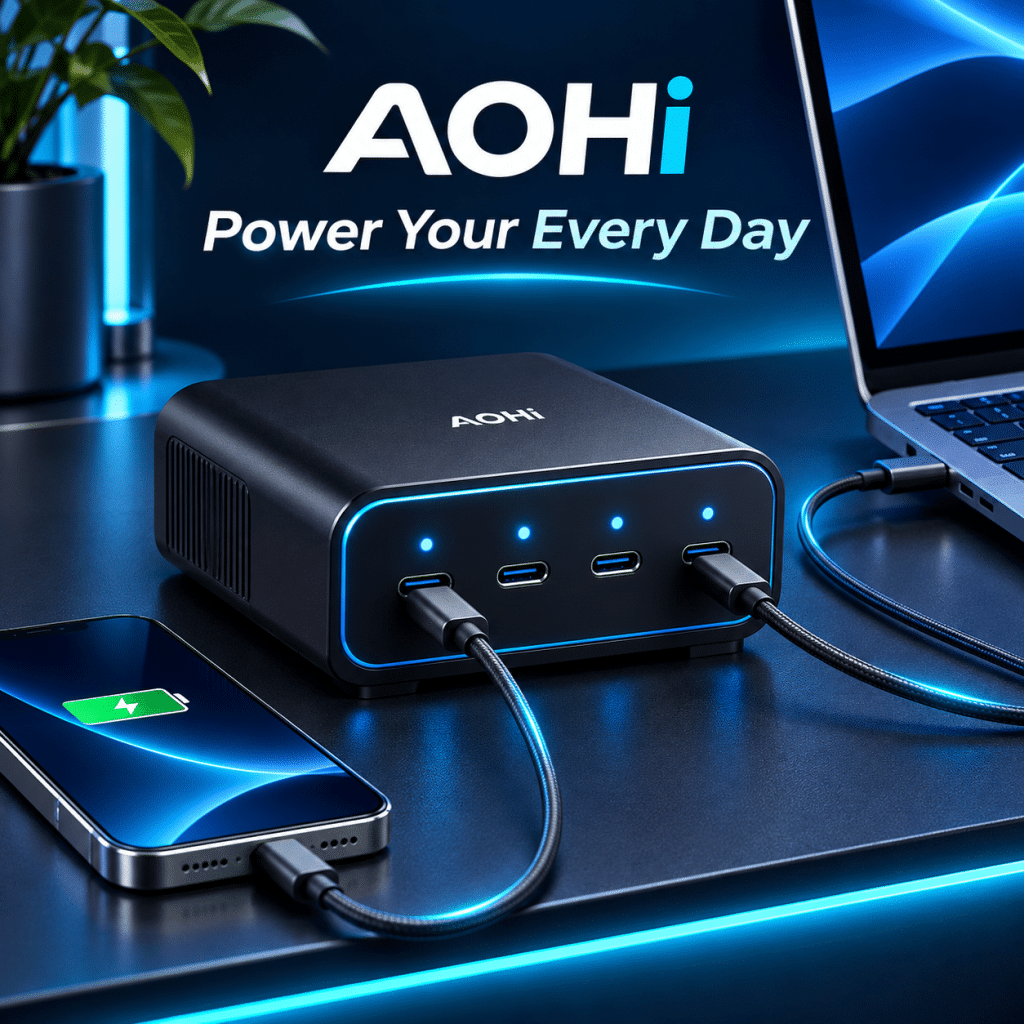
For home or office use, the range includes compact multiport wall chargers as well as larger desktop stations. Listed examples include The Youth models with three ports, a Magcube Pro charger with two USB-C ports and one USB-A port, and The Future AI PD3.2 desktop station with six ports. Product titles identify different maximum power ratings, from 65W and 100W wall chargers to a 170W three-port wall charger and a 280W six-port desktop station. These are listing specifications, not a promise that each port supplies the full stated total to every connected device at once.
For travel beyond an outlet, AOHI lists power banks in several capacities and power ratings. The catalog includes 10,000mAh and 20,000mAh options, a 27,600mAh Starship model described with 240W output, and a 40,000mAh Starship listing described as a 140W charger. Some product titles also mention a built-in LED display and an included USB-C cable. As these product names and descriptions vary, the precise capacity, charging rating and included components should be checked on the individual listing rather than assumed across the whole family.
Car charging is another distinct part of the range. AOHI lists conventional USB-C and USB-A vehicle chargers, including 45W and 65W SuperAuto models, and a newer three-port car charger described as a 170W model with an LED display. It also lists magnetic wireless car chargers, with one product page specifying that a particular model is sold only in the United States. That regional note is a reminder that availability and configuration can differ between products, even within a shared category.
What the product naming tells you—and what it doesn’t
AOHI’s names often combine a family label, a power figure, a port count or a charging standard. Terms such as PD3.1, PD3.2, PPS and GaN appear in product titles, while other listings call out USB4 2.0, 240W or 8K. The names can make it easier to identify the advertised category and headline capabilities. They are not a substitute for checking device compatibility, connector type, port arrangement or the specifications of the connected equipment.
For example, a charger’s total wattage and port count are useful starting points when comparing products, but the available material does not provide a universal power allocation chart for every model and combination of connected devices. Someone choosing a multiport unit for several devices should look for the detailed product information that explains how power is distributed among ports. Similarly, a cable described as supporting a high wattage or a particular data standard should be matched to the charging and data needs of the intended devices; the listing’s headline figure alone cannot confirm the capabilities of an entire setup.
Cable options form a relatively broad part of the store. The listings include standard USB-C to USB-C fast-charging cables, a nylon cable with a digital display, an Adonis USB4 2.0 cable in 3.3-foot and 6.6-foot lengths, and a Creative Power Cable Set described as offering adjustable lengths from 0.33 to 8.53 feet. The site also advertises data and video specifications for some cables, including 40Gbps or 120Gbps and 8K in product names. These attributes are model-specific. A shopper comparing cables should distinguish a charging-focused cable from one whose listing also emphasizes data transfer or video support.
Bundles are another way AOHI groups products. The bundle page pairs charging stations with power banks, wall chargers with cables, and portable batteries with chargers or cable sets. The bundle titles make the intended combination visible, but the collection is not a separate technology category: it is a collection of listed products sold together. Checking the included models is important, especially when comparing bundle names that differ by battery capacity, charger output, cable type or length.
Portable energy and everyday setup choices
The variety of power-bank sizes suggests that AOHI serves more than one kind of portable-power need, though the product pages supplied here do not set out a formal use-case guide. Capacity figures offer a way to compare the listed models, while output ratings indicate the advertised charging capability. They should be considered separately: a larger capacity does not, by itself, tell a buyer how quickly a particular device will charge, and a higher output rating does not state how many full recharges a bank will provide. Those outcomes depend on the devices and usage conditions, which the available pages do not quantify.
Displays are a recurring feature in several product titles, including power banks, cables and some chargers. Their presence distinguishes those models in AOHI’s catalog, but the supplied material does not explain what each display shows or how its information is presented. It is therefore more accurate to treat “LED display” as a listed feature and consult the individual product page for its function, rather than infer a specific readout or monitoring capability.
Plug selection matters for the wall and desktop products. AOHI lists versions for US, EU, UK and AU plug types on the 280W desktop station, and the Youth 140W charger is also listed with US, EU and UK options. Other chargers are presented as specific regional versions. The product listing should be used to confirm the plug configuration before purchase; a product family name alone does not establish which regional variant is being offered.
How AOHI describes its manufacturing and lab resources
Beyond the retail catalog, AOHI’s homepage describes manufacturing and testing infrastructure. The company says its seventh factory, a stated $100 million investment covering 34,000 square metres, was completed at the end of 2023. It describes the facility as incorporating intelligent manufacturing systems and information technologies. This is the company’s own account of its manufacturing footprint; the supplied pages do not independently document the facility or explain how production is divided among particular products.
AOHI also says its laboratory covers 2,000 square metres and contains more than 400 testing machines. The homepage states that the lab passed CNAS certification and that its data was accepted by UL, TUV, IECEE and Intertek. These are claims about the company’s lab and its data as presented by AOHI. The source material does not provide a product-by-product list of tests or imply that each item in the store has received a particular certification.
The company further describes a factory in Indonesia of more than 35,000 square metres, with over 1,100 employees and several automated production lines. AOHI says those lines use an MES system for real-time production-status control and complete data tracking. Taken together, these statements give readers a view of how the brand presents its manufacturing operations, while leaving specific product testing and sourcing details to be verified through individual product documentation where relevant.
Support information and a sensible way to compare products
The storefront states that products come with an 18-month warranty and displays contact information for sales@iaohi.com. Its footer also states free worldwide shipping on orders over $49.99 and says VAT is included, with no additional VAT to pay. These are the terms shown on the supplied pages; shoppers should consult the current product and checkout information for the details that apply to a particular order or location.
A straightforward comparison of AOHI products begins with the setting: wall outlet, desk, vehicle or portable use. Next, check the specific model’s port types and count, regional plug option, stated power rating and any included cable or other item. For a power bank, compare both capacity and output; for a cable, check length and the charging or data specifications that matter to the connected equipment. For bundles, verify the exact components rather than relying only on the bundle’s headline name.
That approach also helps keep the brand’s extensive naming system in perspective. AOHI’s catalog brings together numerous products with overlapping families and headline numbers, but those products are not interchangeable simply because they share a label or visual feature. The useful details sit at the model level: port layout, connector, plug configuration, capacity, stated output and included accessories. The site’s broad range gives shoppers multiple ways to assemble a charging setup, while careful model-by-model comparison is still necessary to determine which configuration fits their devices.
Sponsored by Gabal Global Group, with publishing tools from CheapPlugins.