

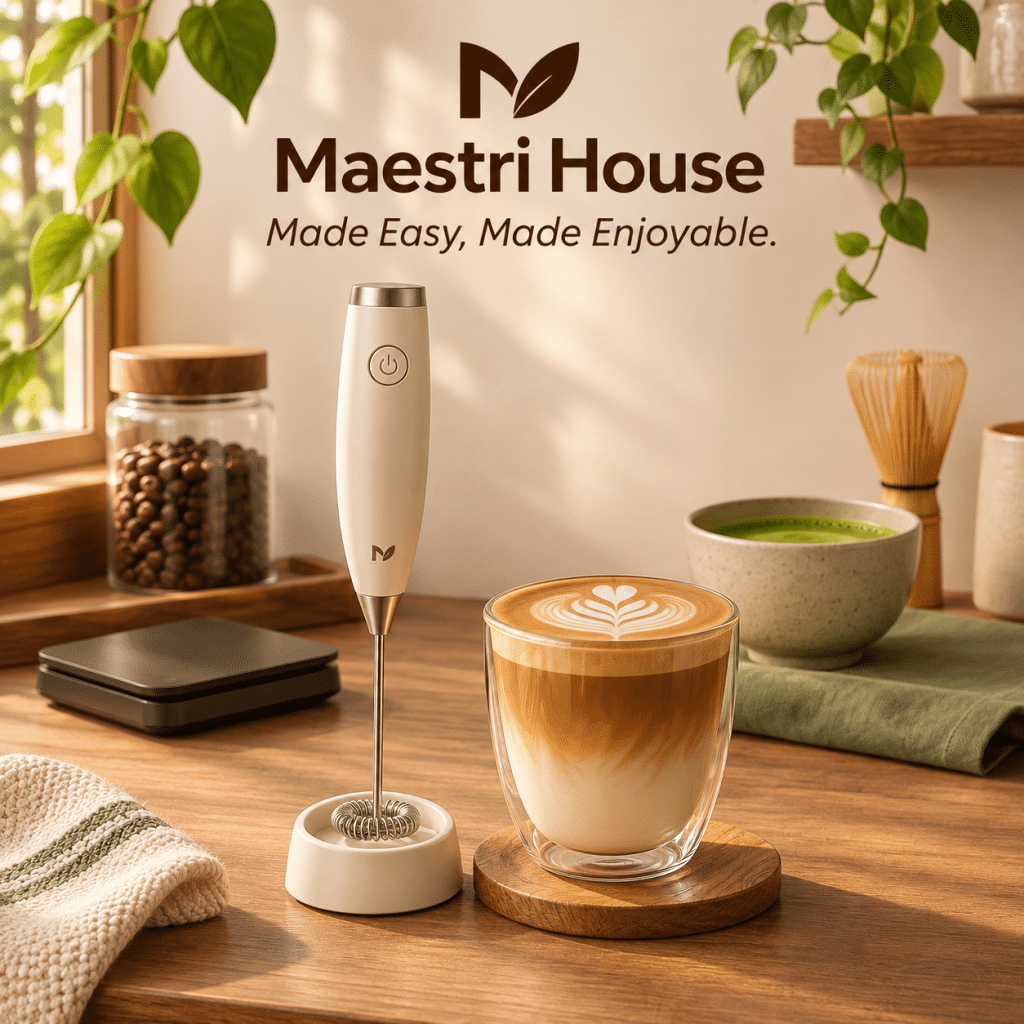
Maestri House presents its kitchen range as a way to make everyday coffee and matcha routines simpler without treating every drink as the same task. Its catalog spans milk frothers, espresso machines, coffee scales, cold brew makers, and matcha sets, with products aimed at home baristas, busy parents, and people exploring coffee. The company’s stated idea, “Made Easy, Made Enjoyable,” is reflected in a collection organized around different steps in preparing a drink rather than around one flagship appliance. Maestrihouse
That breadth makes the company more useful to understand as a maker and seller of drink-preparation tools than as a specialist in just one machine. A customer browsing its site can find equipment for foaming milk, measuring espresso, making cold brew, or preparing matcha. Maestri House also separates several categories by how and where a person might use them: handheld and jug-style frothers, countertop and portable espresso machines, and scales with different brewing displays and functions.
A catalog organized around different routines
The range begins with a practical distinction: not every household prepares drinks in the same quantities or with the same degree of involvement. Maestri House’s milk-frother page describes handheld models as suited to speed and individual cups, detachable pitchers as a fit for families and hot chocolate, and integrated units as an option for limited counter space. These are the company’s own category descriptions, but they reveal how it frames the assortment: as a set of choices shaped by routine, capacity, and available kitchen space.
For someone making a single latte, a handheld frother can be a compact way to add foam without setting up a larger jug. The site lists several rechargeable handheld models, including the LunaFro line, and differentiates some by controls or included accessories. LunaFro 2.0, for example, is described as having stepless speed control. LunaFro 2.0 Plus is listed with three whisks. The site also offers a LunaFro Mini and a LunaFro Lite, alongside other handheld models. The product range is therefore not just a choice between “frother” and “no frother”; it includes variations within the portable format.
For larger servings or more than one drink, Maestri House also sells detachable and integrated frothers. The DualFro products are among the jug-style options, and the homepage highlights the DualFro Ultra as a milk frother and steamer with eight modes. Its listed features include hot and cold use, compatibility with dairy and barista-style plant milk, a keep-warm function, and a dishwasher-safe stainless-steel vessel. The brand also lists the DualFro 600 as a variable-temperature model and the DualFro 400 as an integrated frother with variable temperature. These descriptions give shoppers different configurations to compare without suggesting that one format suits every kitchen.
The company’s own FAQ offers basic use and care guidance for its frothers. It says its handheld models can be used with hot or cold milk, and recommends a deep container when frothing cold milk to help avoid splashing. For hot drinks, it says to heat the milk separately rather than microwave the frother. Its cleaning guidance distinguishes handheld units from pitcher models: detachable whisks can be rinsed or briefly run in water, while pitcher models are described as top-rack dishwasher safe. The base, the FAQ says, should be wiped with a damp cloth and not submerged.
Espresso at home, or away from the counter
Espresso equipment forms another clear branch of the Maestri House range. The site describes two routes: a semi-automatic machine intended for countertop use and a portable machine designed for travel or other settings away from a kitchen counter. This distinction is more useful than treating portability as a minor feature. The two formats call for different preparation habits and offer different capabilities.
The MHCM01 is the listed semi-automatic espresso machine. According to the product information and FAQ, it has a 20-bar ULKA pump, an 8-millimeter steam wand, a 1.3-liter water tank, and a cup warmer. The company also says it has an auto-clean function and describes backflushing the group head with the included cleaning disc as part of cleaning. Its water tank and drip tray are removable for washing, and the steam wand should be wiped after use. The FAQ advises descaling periodically, with timing depending on water hardness.
Those details place the MHCM01 in a more involved kind of home coffee routine: the machine is countertop equipment, and its steam wand allows milk to be frothed as part of preparing a milk-based drink. The machine’s features are presented by Maestri House; they should be read as product specifications, not as a promise about the result in every kitchen. Espresso preparation depends on the coffee and the person using the machine, and the source pages do not provide independent comparisons or performance testing.
The portable espresso machine, identified in the FAQ as GC-CP020, is described differently. Maestri House says it is battery-powered, compact, and self-heating, with a 150-watt heating system that brings cold water to extraction temperature in about two to three minutes. The LCD displays temperature, according to the page. The company also says users can instead add preheated water for brewing. The machine works with ground coffee using an included refillable basket or with NS capsules, which the site describes as Nespresso-style.
That portable model does not include a milk-steaming function. The FAQ suggests using a separate handheld frother for milk-based drinks. This is a useful example of how the company’s broader catalog can be combined across categories: espresso preparation and milk texturing are handled by separate tools in this setup. The source describes travel, camping, and office use as possible settings, but does not give details about battery capacity or the number of drinks per charge.
Measurement and slower brewing
Maestri House’s coffee scales cater to people who want measurement and timing to be part of the brewing process. The homepage describes the S2 Glass Espresso Scale as having a glass surface, 0.1-gram precision, an automatic timer, and a rechargeable design. The S3 is described as a rechargeable coffee scale with brew-ratio and flow-display features, while the S1 is listed as a rechargeable espresso scale with a timer. The Lab section also highlights scales with an automatic timer, rechargeable power, and flow-rate display.
These product descriptions point to a range of ways to monitor brewing, rather than a single scale with every listed function. A timer can help a person track extraction time; a ratio display can relate coffee and water amounts; and a flow-rate display provides another kind of information during brewing. Those are descriptions of features, not claims that a particular scale will improve a cup by itself. The pages do not set out a brewing curriculum or specify which settings are right for a given coffee, so the scale range is best understood as equipment for people who want to measure or observe more of their process.
Cold brew offers a different rhythm altogether. Maestri House lists the CB40, a 40-ounce maker with a 350-mesh filter and a Tritan pitcher. The homepage describes the pitcher as leak-proof and says the filter is intended to produce smooth, residue-free cold brew. Those are the sponsor’s product claims. The capacity and filter specification are useful reference points for shoppers comparing cold-brew equipment, though the source pages do not explain steeping times, recipes, or how many servings the capacity represents.
The collection also reaches beyond coffee. Maestri House lists matcha sets and features Culinary First Harvest Organic Matcha Powder among its popular products. The site’s broad categories include accessories, and its homepage frames the offering as covering coffee and matcha products. This makes the brand’s scope wider than espresso preparation alone, while the available source material remains more detailed about equipment than about matcha preparation.
Choosing by format, not by a single “best” tool
A helpful way to navigate Maestri House’s range is to start with the task and the setting. For occasional foam in one cup, the company’s categories point toward a handheld frother. For several drinks or hot chocolate, its site directs attention to pitcher-style equipment. For a counter-based espresso setup with milk steaming, the MHCM01 offers a different combination of functions from the portable GC-CP020, which is built around travel and can use ground coffee or compatible capsules. For cold brew, the CB40 is the catalog’s identified 40-ounce option, while its scale selection serves people who want timing, weight, ratio, or flow information.
Maestri House does not present the range as a single, uniform system in which every product performs every task. Instead, the product pages and FAQs distinguish formats, describe intended uses, and give selected care or compatibility details. That makes the company’s product organization itself a notable part of its offer: customers can approach a drink-making routine one tool at a time, or consider how separate tools might work together.
The available pages provide a useful overview of categories and selected specifications, but they do not include a detailed corporate history, manufacturing information, or independent assessments of product performance. A careful profile should therefore stay close to what Maestri House publishes: a kitchen-focused brand with a wide range of drink-preparation equipment, from rechargeable handheld frothers to espresso machines, scales, and a cold-brew maker. Its distinctive angle is not one named product, but an assortment arranged around the different ways people prepare coffee and matcha at home or on the go.
Get all details about Maestrihouse
Sponsored by Gabal Global Group, with publishing tools from CheapPlugins.