

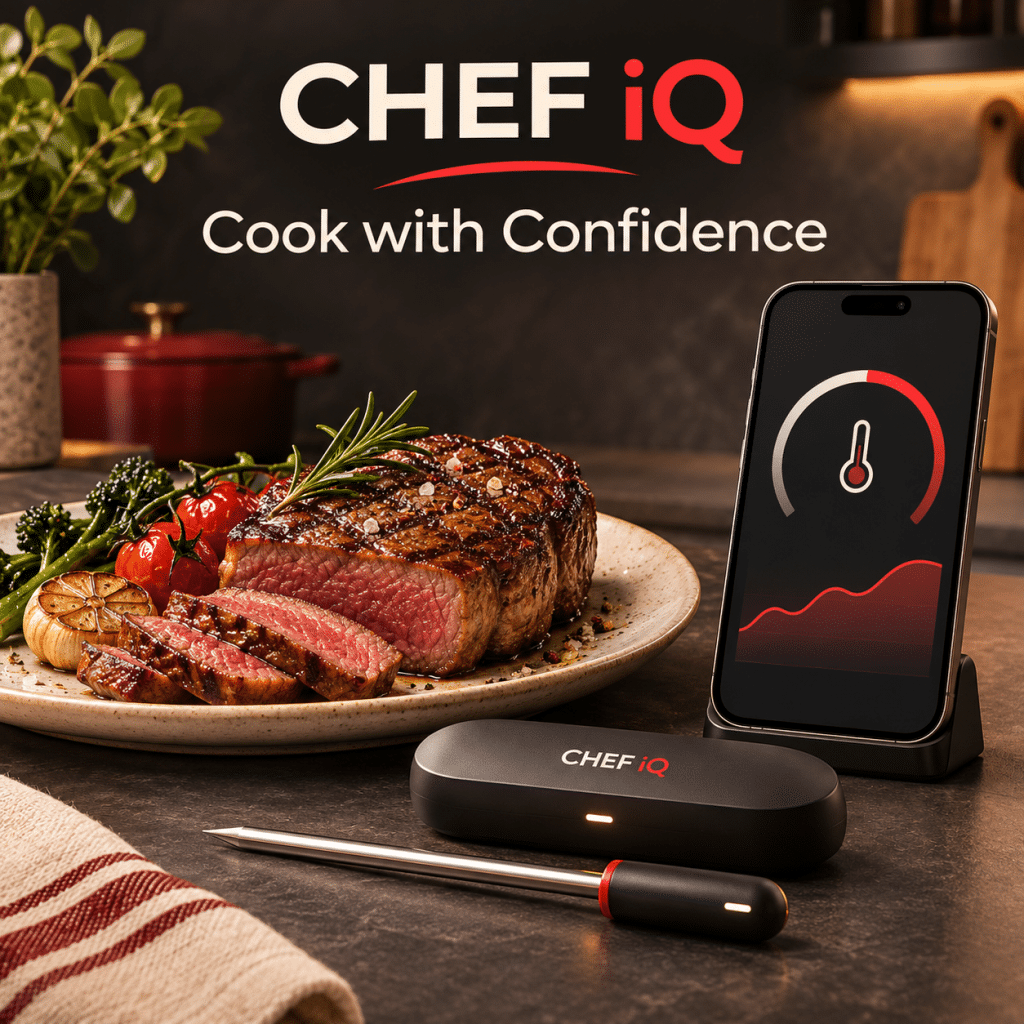
CHEF iQ presents home cooking as a combination of capable appliances, connected tools, and practical guidance. Its range includes the iQ Sense wireless cooking thermometer, the iQ MiniOven countertop oven, and the iQ Cooker multicooker, alongside the CHEF iQ App. Together, these products show how the brand approaches cooking: sensors and presets can help users follow a cooking process, while controls on the appliance and in the app offer different ways to manage it. Learn more about the company and its products at Chefiq.
That approach is more specific than simply adding a phone connection to kitchen equipment. On the product pages, the app is tied to particular tasks: checking food temperature, choosing guided recipes, tracking an oven session, or drawing on presets. The products still have their own onboard controls and capabilities, but the connected features form a common thread. Understanding that distinction helps explain CHEF iQ’s lineup without treating its appliances as interchangeable.
A product range built around different cooking jobs
The brand’s site describes CHEF iQ as a home-cooking company whose products are intended to help people broaden what they cook. Its featured equipment covers several different roles. The iQ Sense is a probe thermometer for monitoring food as it cooks; the iQ MiniOven combines countertop oven functions in one appliance; and the iQ Cooker is presented as a smart multicooker. The company also promotes the CHEF iQ App as a place for recipes and connected controls.
Those distinctions matter. A thermometer measures food and cooking-environment temperatures, rather than replacing an oven or cooker. The MiniOven is a countertop appliance with multiple heating and cooking modes. The Cooker is a separate multicooker in the brand’s portfolio, not a function of the oven. CHEF iQ’s approach is therefore a range of tools that can have connected features in common while addressing different kitchen needs.
The source pages provide the most detail about the iQ Sense and the iQ MiniOven. They identify both as compatible with the app and describe ways the products can work together. The homepage also features the iQ Cooker, but supplies less specification detail about it. A grounded overview of CHEF iQ is consequently best understood through the documented features of the thermometer and oven, while recognizing the multicooker as another part of the product family.
Temperature information with iQ Sense
The iQ Sense is a wireless cooking thermometer built around a probe and a Smart Hub. The probe goes into food, while the hub charges it and relays its readings to a phone or tablet. The product page describes Wi-Fi and Bluetooth connectivity, with the hub acting as the Wi-Fi base station. CHEF iQ says this arrangement enables monitoring from anywhere; the page also describes Bluetooth use when an internet connection is unavailable. The hub has a built-in speaker for audible alerts and charges through USB-C.
The probe’s design is intended for use across a broad list of cooking methods. CHEF iQ lists ovens, stovetops, gas and charcoal grills, smokers, air fryers, deep fryers, and sous vide among the compatible settings. The product page specifies heat resistance up to 1,000°F for the probe and lists a 0.19-inch thickness and 4.75-inch length. It gives an internal temperature range of 32°F to 212°F and an ambient range of 32°F to 1,000°F. The page describes the probe as waterproof, dishwasher safe, and easy to clean.
Temperature sensing is divided between food and surroundings. The listed configuration has four internal sensors and one ambient sensor, for five sensors in total. CHEF iQ states that internal readings are accurate within 1°F and that the probe self-calibrates with each temperature measurement. The ambient sensor is described as monitoring the cooking environment, which gives the app information beyond the temperature inside the food. That distinction is useful when interpreting the product: the probe can report both how the food is progressing and conditions around it.
The app adds estimates and prompts to those readings. According to the product page, it provides real-time temperature updates, estimated cooking times, flip reminders, rest timers, and push notifications. It also offers hundreds of chef-tested presets and video-guided recipes. These are guidance tools rather than a substitute for the user’s decisions: the listed features communicate information and suggest timing, while the person cooking remains responsible for selecting a method and handling the food.
CHEF iQ lists multiple days of probe battery life per charge and says the latest generation offers more than 70 hours of battery life. The hub recharges over USB-C, and the probe and hub have permanent internal rechargeable lithium batteries, according to the FAQ. The box contents listed on the page are a wireless probe, Smart Hub, and USB-C charging cable; a charging brick is not included. These details help clarify what the connected setup consists of: the probe takes measurements, the hub handles charging and data relay, and a smart device provides the app interface.
The iQ MiniOven as a multifunction countertop appliance
The iQ MiniOven is a 25-quart countertop oven with a stated maximum temperature of 500°F. Its 11 listed cooking functions are bake, roast, air fry, dehydrate, toast, slow cook, broil, air broil, reheat, keep warm, and proof. A Dual Cook setting can combine functions back to back, and the product page describes hundreds of presets. In practical terms, the oven’s central proposition is to bring a range of cooking modes and guided settings into one appliance rather than limiting it to a single task.
Its dimensions are listed as 16.1 inches wide, 16.4 inches deep, and 14.4 inches high, with a weight of 37.41 pounds. The 25-quart interior is described as accommodating a 13-inch pizza or a 9-by-13-inch baking tray. The cooking cavity measures 13.54 inches wide by 13.15 inches deep by 6.38 inches high. Those figures provide a more concrete sense of its countertop footprint and usable space than the word “mini” alone might suggest.
CHEF iQ specifies six heating elements—four on top and two on the bottom—and a 3,200 RPM DC motor. The page describes the interior as custom stainless steel designed for heat reflectivity and retention. It also lists natural-tone interior lighting, an edge-to-edge viewing window, a soft-close door, and a cool-touch handle. These design details sit alongside the cooking modes: they describe how the appliance is arranged and operated, rather than adding another cooking function.
The MiniOven can connect to the CHEF iQ App over Wi-Fi and Bluetooth. The app is described as offering remote monitoring and control, and the oven records cooking history so users can return to previous meals. The FAQ adds an important operational qualification: the oven can work without additional peripherals, although first use requires linking it to a CHEF iQ account. Most cooking functions can be started remotely, but broil, air broil, and toast require the cooking session to be set up in the app and then started at the oven. The door must be closed for remote starting.
The included accessories listed for the oven are a mini glide rack, ceramic-coated baking tray, ceramic-coated MiniRounds tray, wire rack, and air fryer/dehydrator rack. The page notes that a pizza stone, muffin tray, and grill pans are not included and are sold separately. Listing the included pieces separately from optional accessories makes the product’s configuration clearer, especially for people comparing the oven’s advertised functions with the equipment supplied in the box.
Where the connected products meet
CHEF iQ describes the iQ Sense as pairing with the MiniOven. This creates a useful connection between two distinct tools: the oven supplies the cooking environment, while the probe measures the food and sends information through its hub. The product pages describe the pairing as straightforward, and the MiniOven page says it can cook by temperature when used with the thermometer. The available material does not mean that every cooking mode requires the probe; the oven’s own functions and controls are presented as usable on their own.
That combination illustrates the broader shape of CHEF iQ’s connected-cooking idea. The appliance provides heat and selectable modes, while the thermometer can provide a more direct view of food temperature. The app serves as an interface for settings, information, recipes, and alerts. Each component has a separate role, and the pairing is presented as an option for users who want to connect cooking conditions with measured food temperature.
The brand’s homepage also features the iQ Cooker, calling it a smart multicooker, and highlights the CHEF iQ App. It includes a published contributor’s description of the cooker’s built-in scale and app recipes, but the supplied product material does not provide a dedicated specification page for the Cooker. It is therefore possible to identify the multicooker as part of the range, but not to give the same detailed account of its settings, capacity, or operating procedure as the source supports for the MiniOven and iQ Sense.
What the app adds—and what the pages establish
Across the documented products, the app is not presented as a single generic feature. With iQ Sense, it displays temperature information and sends timing prompts and alerts. With the MiniOven, it supports presets, remote monitoring, and many remote starts. The oven also has a color touchscreen control panel and built-in speaker, while the thermometer’s hub has its own speaker. The result, as described on the pages, is a mix of phone-based tools and direct appliance feedback rather than an app-only system.
CHEF iQ’s materials emphasize guided cooking, but the supplied facts are concrete: presets, recipes, video guides, temperature readings, estimated finish times, reminders, and controls. These features can help users follow a cooking process, but the pages do not establish that every recipe, setting, or result will be suitable for every ingredient or preference. The company’s stated aim is to empower people to cook and expand their culinary horizons; the product descriptions show the specific connected functions it offers in support of that aim.
For someone exploring CHEF iQ, the clearest starting point is the task at hand. The iQ Sense is the product centered on temperature measurement across varied cooking environments. The iQ MiniOven is the countertop appliance with 11 functions, a 25-quart interior, and app-connected operation. The iQ Cooker rounds out the featured range as a multicooker, although the available pages offer fewer details about it. Seen this way, CHEF iQ is not simply one appliance or one cooking method, but a brand assembling different tools around a shared emphasis on guidance, measurement, and connected control.
Sponsored by Gabal Global Group, with publishing tools from CheapPlugins.