

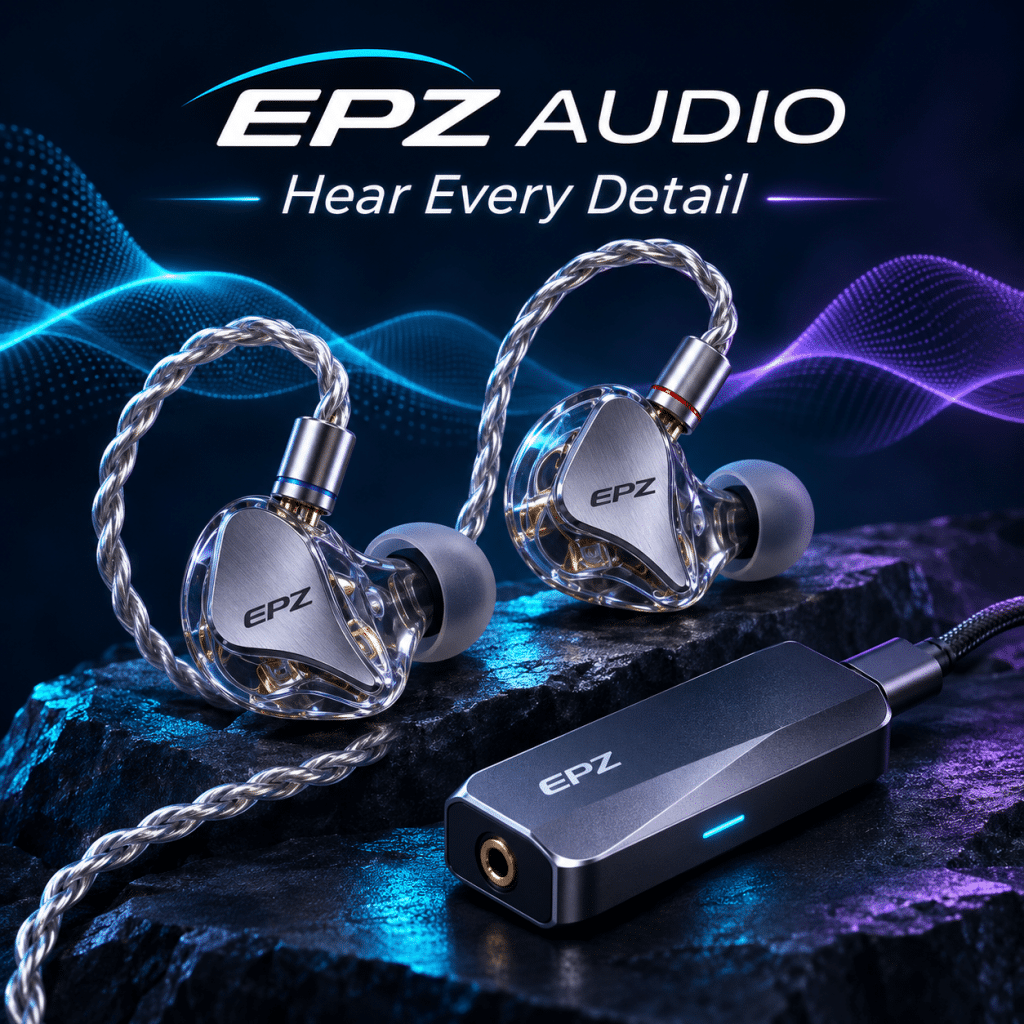
EPZ Audio is not a single-product storefront: its catalog spans music-focused in-ear monitors, gaming IEMs, portable DACs, and accessories. The company’s official store presents these as parts of a wider listening setup, with products grouped by use and by design. Its stated approach also links acoustic development with shell production, tuning, and final quality control. That combination makes EPZ Audio Epzaudio a useful subject as a maker and seller of several kinds of personal-audio equipment, rather than as the source of one headline device.
The store’s range points to two distinct listening contexts. Its hi-fi IEM section is aimed at music listening and offers different tunings and driver designs, while its gaming section is organized around game audio and voice chat. A third category, DACs and accessories, addresses equipment that can sit alongside earphones in a portable or gaming setup. The pages do not present one universal configuration as right for every listener; instead, they show a product family with different formats and purposes.
A catalog organized around how people listen
EPZ’s hi-fi collection is described as a range of wired in-ear monitors for music. The category page says that the models vary in tuning and driver design, and lists products including the 550, K9, P50, P40, K5, and Q5 Pro. This gives the range a clear organizing idea: listeners can compare products within one broad use case without assuming that every model uses the same acoustic approach. The source pages do not provide full specifications for each item, so the model names alone should not be taken as evidence of particular performance differences.
Some examples on the store’s front page do identify driver arrangements and intended sound characteristics. EPZ describes the 550 as using five balanced armatures and a three-way crossover, with a presentation it characterizes as clear, controlled, and smoothly extended. The P40 is presented as a tribrid design combining two dynamic drivers, a planar driver, and a piezoelectric (PZT) driver. EPZ associates that combination with weight in the lows, vocal focus, and high-frequency detail. Those descriptions are the company’s own product framing, not a substitute for a complete specification sheet or an independent assessment.
The broader hi-fi page also mentions custom HiFi in-ear monitors, studio IEMs, self-developed drivers, balanced sound, and resin shells. It promotes customization and refers to medical-grade resin, but does not explain the material’s testing, standards, or exact scope on the supplied page. The store additionally describes bespoke options for custom colors and fit when needed. Taken together, these details suggest that customization is part of the brand’s offering, though the pages do not define which models or configurations qualify or how a bespoke order is arranged.
That distinction matters for shoppers comparing standard products with customized options. The catalog names several ready-to-browse models, while the bespoke language points to a separate possibility for color or fit. The supplied pages do not specify a fitting process, turnaround time, or the available range of custom choices. A reader can therefore understand that EPZ offers bespoke options, but would need the company’s current product or support information to establish what is available for a particular order.
Gaming earphones built around connection choices
EPZ’s gaming IEM category is aimed at both game audio and voice chat. Unlike the hi-fi page, which emphasizes music listening and different tunings, the gaming page highlights practical setup variables: 3.5 mm and USB-C connection options, plus inline or boom microphones. That framing makes connection type and microphone arrangement central points of comparison. Which option suits a particular player depends on the device and preferred communication setup; the source pages do not claim compatibility with every console, computer, or mobile device.
The gaming lineup includes the G30, G20 Pro, G20, G10 Pro, and G10. The store describes the G20 Pro more specifically as having a 10 mm composite driver, esports-tuned digital signal processing, dual microphones, and a stated 3.9-gram fit. These are product details supplied by EPZ. The source does not clarify whether the weight refers to one earpiece or another measurement basis, so it is best read as the store’s listed fit-related figure rather than expanded into a broader comfort claim.
Elsewhere, EPZ uses phrases such as “positioning” and “hear the game clearly” to describe the purpose of its gaming products. Those are promotional descriptions of intended use, not guarantees of competitive advantage or measured sound performance. More concretely, the category page lets shoppers distinguish between wired options and microphone formats. For someone assembling a gaming setup, those distinctions can guide the first questions: which connector is needed, and how will voice communication be handled?
The gaming range also shows that the brand is not treating gaming audio as simply another label for its music IEMs. Its category page explicitly connects the products to gaming and voice chat, while the front page calls out a particular DSP and microphone configuration for the G20 Pro. The pages do not provide detailed latency measurements, platform certifications, or comparative performance tests, so no such conclusions follow from the descriptions. What they do establish is that EPZ markets dedicated models for this context and offers multiple connection and microphone configurations across the range.
Portable DACs and the rest of the setup
Alongside earphones, EPZ lists portable DACs and a gaming DAC. The named products include the TP65 Portable DAC, TP35 Pro Portable DAC, TS01 Gaming DAC, and TP15 Portable DAC Dongle. The store positions these as ways to upgrade parts of a listening setup, but the supplied page does not give detailed conversion specifications, supported formats, output power, or device compatibility. It is therefore possible to describe the range and its intended role, but not to compare the DACs technically from these materials alone.
The presence of both portable and gaming DAC listings broadens the company’s focus beyond the earpieces themselves. For a prospective buyer, that creates a reason to consider the whole signal chain: the source device, the connector, whether an added DAC is wanted, and the earphones or microphone arrangement being used. The pages establish that EPZ sells products in each of these broad categories; they do not say that a particular IEM requires one of the listed DACs, or that all items are designed to work together in every configuration.
The accessories list includes M100 liquid silicone eartips. Their presence is a reminder that the eartip is another part of an in-ear setup, separate from the driver and shell. However, the source does not describe the M100’s available sizes, acoustic effect, or compatibility across EPZ and other brands. Readers should not infer those details from the product name alone and would need to consult the relevant listing for specifics.
Production as part of the company’s design story
EPZ describes its process as keeping acoustic development, shell production, tuning, and final quality control closely connected. It says that feedback from listeners and partners is incorporated throughout this work. This is the company’s account of its development approach; the supplied pages do not explain the testing methods, the number of development stages, or how feedback is evaluated. Even so, the description reveals an emphasis on coordinating the physical construction of an IEM with its acoustic design rather than presenting those activities as entirely separate.
The store also says EPZ develops its own DLP 3D printers and resin materials. It connects that in-house equipment and material work to consistent shell structures at scale, and says that high-precision internal structures help stabilize the acoustic system and keep left and right channels consistent. These statements describe the company’s rationale for its manufacturing choices. They should be understood as EPZ’s claims about its process, not as independently verified measurements of production consistency.
Shell production is particularly relevant to in-ear monitors because the shell is the physical structure housing the internal components. EPZ’s page ties that structure to its acoustic system and also mentions custom colors and fit as bespoke options. The company’s process description therefore links manufacturing capability to both repeatability and customization. The supplied information does not specify how its DLP approach compares with other manufacturing methods, nor does it provide production tolerances, so the useful takeaway is the connection EPZ itself draws between shell construction and its product development.
EPZ also points to community setups under the phrase “Technology Seen in the Wild.” That section is presented as real setups from the EPZ community. It situates the products within users’ audio arrangements, but the source text does not identify particular users, gear combinations, or technical results. It is best read as a window into how the company presents its community rather than as evidence about how a particular product will perform for an individual buyer.
How to read the range
For a person exploring EPZ, the most practical starting point is the intended use category. The hi-fi collection is framed for music listening, the gaming range for game audio and voice chat, and the DAC section for additional portable or gaming equipment. From there, the pages suggest comparing model-level details that are actually listed: driver arrangement where provided, connector type, and microphone configuration. EPZ’s descriptions give a first orientation, while the available information does not support a complete technical comparison across every model.
The same careful approach applies to bespoke products. The store advertises customization, including custom colors and fit when needed, but does not give the ordering details in the material available here. Anyone considering a custom option would need to confirm its scope and requirements directly through the company’s current product information. Likewise, shoppers who need a particular connector, device compatibility, DAC capability, or eartip size should check those specifics rather than assume them from category labels.
Overall, EPZ Audio’s identity in these pages comes from the breadth of its personal-audio catalog and the production process it says supports that range. Its offer brings together music IEMs, gaming-oriented earphones, DACs, accessories, and bespoke possibilities. The company also emphasizes coordination among acoustic development, tuning, shell production, and quality control, including its stated use of in-house DLP printing and resin work. For readers, that makes EPZ a brand to evaluate by matching the particular product’s stated format and use case to their own setup, while treating promotional sound descriptions and manufacturing claims as the company’s account unless fuller technical evidence is available.
Get all details about Epzaudio
Sponsored by Gabal Global Group, with publishing tools from CheapPlugins.