

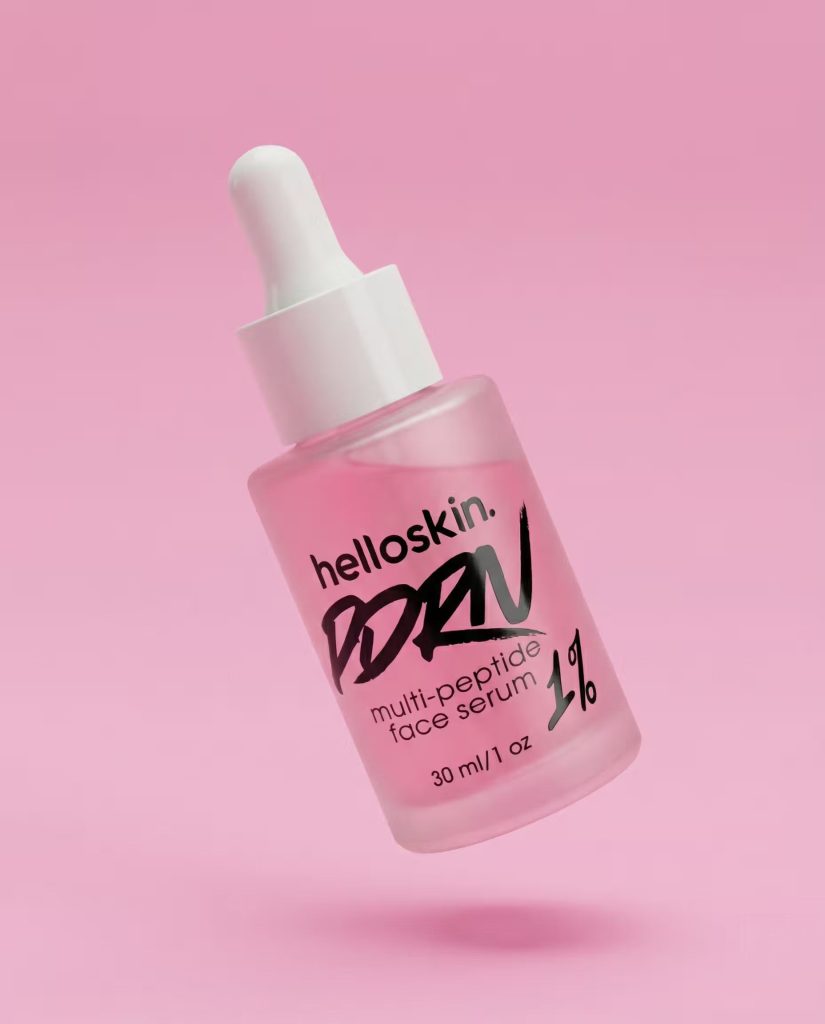
Helloskin’s PDRN 1% Salmon DNA Multi Peptide Repair Serum is built around a salmon-derived ingredient, but its product page describes a broader formula than that headline alone suggests. The brand presents it as a combination of PDRN, peptides, niacinamide, multiple forms of hyaluronic acid and other supporting ingredients. For shoppers comparing formulas, one detail deserves attention at the outset: the page uses both 1% and 1.2% figures for the PDRN concentration. Helloskinco is the seller, and the product is listed in the face-serum category.
That discrepancy matters because concentration is a central part of the product’s positioning. The title and an opening description identify the serum as 1% PDRN, while other product-page copy calls it a 1.2% PDRN formula. The page also supplies specific percentages for niacinamide and peptides in some sections. Rather than treating every number as consistent, it is useful to read the listing as the brand’s description of a multi-part formula and check the current packaging or ingredient information for the exact figures.
The formula extends beyond its PDRN headline
PDRN, described on the page as salmon DNA fragments, is the serum’s central ingredient and the basis of its name. The brand frames it as a Korean-skincare-inspired active and emphasizes that the product contains salmon-derived material rather than using “PDRN” only as a broad marketing phrase. Its more detailed product copy specifies 1.2% pure PDRN; elsewhere, the product title and initial description say 1%. That variation should be kept in view when comparing the serum with products that state a single concentration.
The supporting ingredients are a substantial part of how Helloskin describes the product. The listing names a peptide system, niacinamide, Pro-Vitamin B5, adenosine and four forms of hyaluronic acid. In another section, the brand gives the peptide blend as 4% in total, divided into 2% Palmitoyl Tripeptide-1 and 2% Palmitoyl Tetrapeptide-7. It identifies niacinamide at 3% in the same formula breakdown. The opening description, meanwhile, calls out Matrixyl 3000 as two collagen-support peptides without specifying percentages. These details point to a formula presented as a combination, not a single-ingredient PDRN treatment.
Hyaluronic acid is described as a four-form or “4-layer” hydration system. The product page’s emphasis is on the serum’s intended hydrated, cushioned feel and on supporting skin that looks plumper or bouncier. Those are the brand’s descriptions of the formula’s appearance and sensory aims, not a guarantee of a particular result. The source does not name the four individual forms, so shoppers seeking their specific identities would need to consult the full ingredient list or product packaging.
What the named supporting ingredients contribute to the story
Niacinamide is positioned by Helloskin as a daily support ingredient for a complexion that looks more balanced, even and smooth. The product copy calls out 3% in its detailed formula section, while the broader description simply lists niacinamide among the serum’s components. The brand’s stated approach is to place this ingredient alongside PDRN and hydration rather than present the serum as a niacinamide-only product. The source does not provide usage directions or comparative testing, so it does not establish how the serum performs against other formulas.
The two peptides are identified by name in the more detailed listing: Palmitoyl Tripeptide-1 and Palmitoyl Tetrapeptide-7. Helloskin describes them as support peptides and associates them with the appearance of bounce, smoothness and structure. The opening product description also refers to Matrixyl 3000. Since the page does not explain the relationship between that named complex and the two peptide percentages in every section, a careful reading is to note both descriptions rather than assume that the wording is perfectly uniform.
Pro-Vitamin B5 and adenosine appear in the opening formula description, as does a Centella Asiatica complex with two isolated active compounds. The brand says the Centella component supports skin that looks calmer, clearer and more resilient. These are brand-stated aims; the source does not give the identities of the two isolated Centella compounds or explain their individual proportions. Their presence nevertheless indicates that the product is presented as a multi-ingredient serum rather than a minimal PDRN-and-water blend.
The page also makes a specific claim about the serum’s soft pink colour: it says the colour comes from Vitamin B12 and is not a dye. This is useful context for understanding the product’s appearance, particularly because the listing draws attention to the pink tone as part of its presentation. It does not, by itself, provide information about the serum’s stability over time, and the source does not offer storage guidance or a description of how its colour may change.
Texture, routine position and product identity
Helloskin positions the serum as a daily product and describes its intended feel with words such as juicy, lightweight, cushioned and hydrating. The page suggests that it can fit into a morning or evening routine, but the supplied material does not give a complete application sequence, a stated amount to use, or instructions about layering it with other products. Anyone who needs those specifics should rely on the product’s current packaging or directions rather than infer them from the marketing description.
The product’s concept brings together three kinds of support in the brand’s own account: the PDRN headline, the peptide and niacinamide combination, and hydration from four forms of hyaluronic acid. That grouping helps explain why the listing repeatedly presents the serum as more than a salmon-DNA trend product. For a shopper, the practical point is not that every ingredient has a separately demonstrated outcome in the supplied material; it is that the manufacturer has chosen to describe the formula through several coordinated ingredient categories and a hydrated-skin finish.
The name also signals the product’s intended focus. “Repair Serum” is part of the title, while the accompanying copy speaks in terms of skin that looks fresher, smoother, more even and bouncy. These are appearance-oriented descriptions on the brand’s page. The source does not provide clinical study details, methods, participant information or measured outcomes that would allow those statements to be independently evaluated. Keeping that distinction clear makes it easier to understand the product without treating promotional language as a proven result.
Formulation details and sensitivities to note
Helloskin says the serum contains 27 ingredients and that each has a purpose. It also states that the formula has no fragrance and no essential oils, and describes itself as avoiding filler botanicals. These are useful formulation details for people who prefer to check for fragrance or essential oils in a face serum. The provided page text does not include the complete ingredient list in a readable form, however, so it cannot answer every ingredient-specific question or establish that the product suits an individual’s particular sensitivities.
The brand explicitly notes that the serum contains fish-derived ingredients because its PDRN comes from salmon DNA. Its product copy advises patch testing for people with seafood sensitivity. That caution is especially relevant to the formula’s defining ingredient: someone who avoids fish-derived materials may also want to consider that sourcing detail before choosing the product. The page does not describe an alternative, fish-free version.
The listing describes the serum as formulated and made in Australia. Separate site copy says orders are handled from an Australian warehouse, but that is a fulfilment detail rather than a feature of the formula itself. For readers focused on the product, the relevant point is the maker’s stated Australian formulation and production, alongside the listed ingredients and the salmon-derived source of PDRN.
How to read the product page when comparing serums
When comparing this serum with another PDRN product, start with the details the listing actually supplies: the salmon-derived PDRN claim; the differing 1% and 1.2% concentration figures; the named peptides; the stated 3% niacinamide and 4% peptide system in the detailed copy; and the four-form hyaluronic acid description. The listing does not identify the individual hyaluronic acid forms, and its descriptions do not use the same PDRN percentage throughout. Those are limits on what can be confidently compared from the page alone.
It is also worth separating formulation information from brand claims about appearance. Ingredients and named percentages describe what Helloskin says is in the formula. Phrases about smoother-looking texture, glow, comfort, bounce or resilience describe the product’s intended positioning. The provided material does not establish that every user will see those effects, and it does not supply a clinical report to assess them. A reader can use the ingredient information to understand the product’s design without reading the marketing language as a promise of individual results.
In short, the PDRN 1% Salmon DNA Multi Peptide Repair Serum is presented as a multi-active face serum with a salmon-derived centerpiece and a supporting blend of peptides, niacinamide, hyaluronic acid, Pro-Vitamin B5, adenosine, Centella components and Vitamin B12. Its most important qualification is also its clearest information gap: the product page alternates between 1% and 1.2% PDRN. The page offers a detailed formula concept and several named ingredients, while leaving some points—including the precise PDRN figure, the individual forms of hyaluronic acid and complete use directions—to be confirmed from the current label or product information.
Get all details about Helloskinco
Sponsored by Gabal Global Group, with publishing tools from CheapPlugins.